
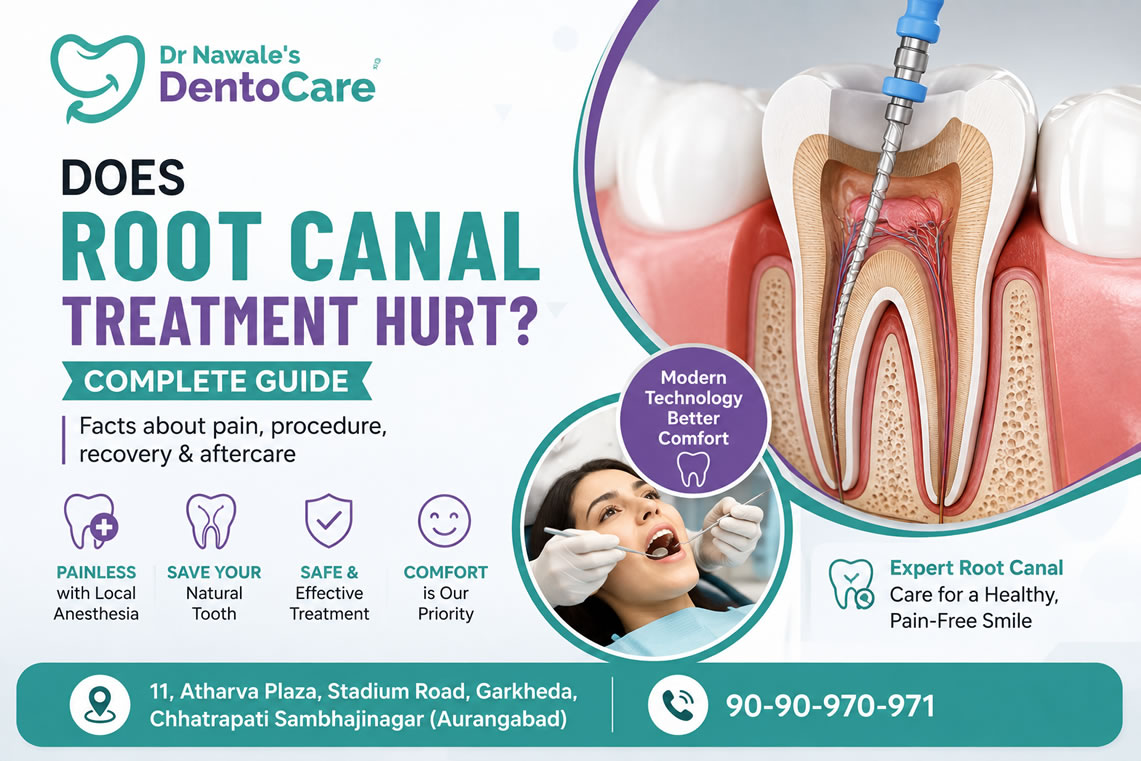
Does root canal treatment hurt? This is one of the first questions many patients ask when their dentist recommends a root canal. The fear of pain can make people delay treatment, even when a tooth is infected or severely damaged.
The good news is that modern root canal treatment is performed using local anesthesia to numb the treatment area, so patients generally should not feel significant pain during the procedure. You may feel pressure, vibration or movement, but sharp pain should be addressed immediately by your dentist.
Some tenderness or soreness can occur after treatment while the tissues around the tooth recover. The amount of discomfort varies from person to person and depends on factors such as the severity of infection, the condition of the tooth and the complexity of treatment.
At Dr Nawale’s DentoCare in Garkheda, Chhatrapati Sambhajinagar (Aurangabad), our approach is to first understand the cause of tooth pain and then recommend the most appropriate treatment for the individual patient.
Table of content
- Does Root Canal Treatment Hurt?
- Why Do People Fear Root Canal Treatment?
- What Is Root Canal Treatment?
- Why Does a Tooth Need a Root Canal?
- What Are the Signs You May Need a Root Canal?
- Does Root Canal Treatment Hurt During the Procedure?
- What Does Root Canal Treatment Feel Like?
- Root Canal Treatment: Step-by-Step
- Is Root Canal Treatment More Painful Than the Toothache?
- What Causes Pain After Root Canal Treatment?
- How Long Does Root Canal Pain Last?
- What Should You Do After Root Canal Treatment?
- What Can You Eat After a Root Canal?
- Root Canal Treatment vs Tooth Extraction
- Can Root Canal Treatment Save Your Natural Tooth?
- Root Canal Myths vs Facts
- When Should You Visit a Root Canal Dentist?
- Why Choose Dr Nawale’s DentoCare?
- Expert Dental Team in Chhatrapati Sambhajinagar
- Frequently Asked Questions
- Final Takeaway
What Is a Digital Intraoral Scanner?
Usually, no significant pain should be felt during the procedure.
Root canal treatment is normally carried out under local anesthesia. The dentist first numbs the area around the affected tooth before beginning treatment.
You may feel:
- A brief sensation when the anesthetic is administered
- Pressure around the tooth
- Vibration from dental instruments
- Water spray
- Movement around the treated tooth
However, the purpose of local anesthesia is to prevent pain during treatment.
If you feel discomfort during the procedure, tell your dentist immediately. Additional measures can be taken to improve your comfort before treatment continues.
After the procedure, the tooth may feel tender or sore for some time. This is different from the severe pain that may have been caused by the original infection.
Why Do People Fear Root Canal Treatment?
The phrase “root canal” often creates anxiety because many people have heard stories about painful dental treatment.
Dental techniques have changed significantly over the years. Today, dentists use local anesthesia and modern instruments to make treatment more comfortable and predictable.
Another reason for the fear is that people often associate root canal treatment with the severe toothache they experienced before treatment.
In reality, the infected or inflamed tooth is often the source of the pain, while root canal treatment is intended to treat that problem.
If you have been postponing treatment because you are worried about pain, discussing your concerns openly with your dentist can help you understand what to expect.
What Is Root Canal Treatment?
A root canal treatment (RCT) is a dental procedure used to treat a tooth when the soft tissue inside it, called the pulp, becomes inflamed or infected.
The pulp contains nerves and blood vessels.
Deep decay, cracks, trauma or other damage can allow bacteria to reach the pulp.
If the affected pulp cannot recover, treatment may be required to remove the infected tissue.
In simple terms:
Deep cavity / crack / injury
↓
Pulp becomes inflamed or infected
↓
Toothache / sensitivity / pain while biting
↓
Dental examination
↓
Root canal treatment when indicated
↓
Infected pulp removed
↓
Root canals cleaned and sealed
↓
Tooth restored
Root canal treatment is therefore not simply a treatment for “tooth pain.” It is a procedure used to treat a specific problem inside the tooth.
Why Does a Tooth Need a Root Canal?
Several conditions can damage the pulp inside a tooth.
Deep Tooth Decay
When tooth decay progresses deep into the tooth, bacteria can reach the pulp.
Cracked or Broken Tooth
A crack can provide a pathway for bacteria to reach the inner portion of the tooth.
Dental Trauma
A strong impact or injury can damage the pulp, sometimes even when the visible damage appears minor.
Repeated Dental Treatment
Repeated procedures on the same tooth can sometimes affect the pulp.
Dental Infection or Abscess
An untreated infection may spread beyond the tooth and cause swelling or an abscess.
A dentist needs to examine the tooth before deciding whether root canal treatment is appropriate.
What Are the Signs You May Need a Root Canal?
A tooth that requires root canal treatment may produce different symptoms.
Common signs include:
- Severe or persistent toothache
- Pain while chewing
- Prolonged sensitivity to hot or cold
- Swelling near the tooth
- Tender gums
- A pimple or small bump on the gums
- Deep tooth decay
- Cracked or damaged tooth
- Darkening or discoloration of the tooth
- Repeated pain in the same tooth
Important:
Tooth pain does not automatically mean you need a root canal.
Sensitivity, cavities, gum problems, cracks and other dental conditions can also cause pain.
A proper dental examination is necessary to identify the actual cause.
Does Root Canal Treatment Hurt During the Procedure?
For most patients, effective local anesthesia makes root canal treatment comfortable during the procedure.
Local anesthesia temporarily blocks pain signals from the treatment area.
You remain awake, but the tooth and surrounding tissues are numbed.
You may notice:
| During Treatment | What You May Experience |
|---|---|
| Anesthetic injection | Brief pressure or discomfort |
| Numbing | Reduced sensation |
| Dental instruments | Vibration and pressure |
| Cleaning | Movement or pressure |
| Root canal filling | Pressure or vibration |
| After treatment | Temporary numbness and possible tenderness |
If you feel sharp pain during treatment, inform your dentist.
Never hesitate to tell your dentist that you are uncomfortable.
What Does Root Canal Treatment Feel Like?
Many patients expect root canal treatment to feel painful throughout the procedure.
The actual experience is usually different.
Once the tooth has been adequately numbed, you may mainly notice:
- Pressure
- Vibration
- Water
- Sounds from dental instruments
- Your dentist working around the tooth
The experience can vary depending on the tooth, level of infection, inflammation and individual sensitivity.
If you are nervous about dental treatment, tell your dentist before the procedure. Understanding each step can make the experience easier.
Root Canal Treatment: Step-by-Step
Understanding the procedure can help reduce dental anxiety.
Step 1: Examination
Your dentist evaluates your symptoms and examines the tooth.
Dental imaging may be recommended when necessary to understand the tooth and surrounding structures.
Step 2: Local Anesthesia
The treatment area is numbed before the procedure begins.
Step 3: Access to the Tooth
A small opening is created to reach the pulp and root canal system.
Step 4: Removal of Infected Pulp
The affected pulp tissue is removed.
Step 5: Cleaning and Shaping
The root canals are cleaned and shaped to remove debris and prepare them for sealing.
Step 6: Filling and Sealing
The cleaned canals are filled and sealed.
Step 7: Final Restoration
Depending on the condition and location of the tooth, the tooth may require a permanent filling or dental crown to restore its strength and function.
Root Canal Treatment in One Simple Flow
Examination
→ Anesthesia
→ Access
→ Pulp Removal
→ Cleaning
→ Shaping
→ Filling & Sealing
→ Final Restoration
Is Root Canal Treatment More Painful Than the Toothache?
This is an important question.
Many patients seek root canal treatment because they are already experiencing:
- Throbbing toothache
- Pain while chewing
- Hot or cold sensitivity
- Swelling
- Pain that interferes with sleep or daily activities
The purpose of root canal treatment is to address the diseased tissue inside the tooth.
Therefore, it is useful to distinguish between:
Pain caused by the dental problem
and
Temporary discomfort associated with treatment and healing
What Causes Pain After Root Canal Treatment?
Some patients experience tenderness after treatment.
This does not necessarily mean something has gone wrong.
The tissues around the tooth may remain sensitive while they recover.
Post-treatment discomfort can be influenced by:
- The severity of the original infection
- Inflammation around the tooth
- The complexity of the root canal system
- The condition of the surrounding tissues
- Individual healing response
- Whether the tooth requires further restoration
Mild soreness generally improves with time.
If you experience severe, increasing or persistent pain or significant swelling, contact your dentist for an evaluation.
How Long Does Root Canal Pain Last?
There is no single recovery time that applies to every patient.
Some patients experience very little discomfort after treatment, while others may notice soreness for several days.
The important point is that the discomfort should generally trend toward improvement.
Contact your dentist if:
- Pain is becoming worse
- Severe pain continues
- Significant swelling develops
- You develop symptoms that concern you
- The tooth remains very painful when biting
- Your symptoms do not improve as expected
Your dentist can determine whether additional treatment or evaluation is required.
What Should You Do After Root Canal Treatment?
Following your dentist’s instructions is an important part of recovery.
Do:
- Follow the post-treatment instructions provided by your dentist
- Brush your teeth regularly
- Maintain good oral hygiene
- Attend scheduled follow-up appointments
- Protect the treated tooth from unnecessary pressure
- Complete the recommended permanent restoration
Avoid:
- Biting hard objects
- Chewing very hard foods on an unrestored tooth
- Delaying the final restoration
- Ignoring persistent pain or swelling
- Skipping follow-up appointments
If a temporary filling has been placed, take extra care with the treated tooth until your dentist completes the recommended restoration.
What Can You Eat After a Root Canal?
Immediately after treatment, your mouth may remain numb because of the local anesthetic.
It is safer to avoid chewing until normal sensation returns so that you do not accidentally bite your cheek, lip or tongue.
After the numbness has worn off, your dentist may recommend softer foods depending on the condition of the tooth and the restoration.
Soft food options may include:
- Khichdi
- Dal and rice
- Soft vegetables
- Curd
- Soft roti
- Eggs
- Oatmeal
- Soft fruits
Avoid very hard or sticky foods if your dentist has advised you to protect the treated tooth until the final restoration is completed.
Root Canal Treatment vs Tooth Extraction
When a tooth is infected, some patients immediately think:
“Why not remove it?”
Extraction may be necessary when a tooth cannot be predictably restored.
However, if a tooth can be successfully treated and restored, preserving the natural tooth may be a valuable option.
| Root Canal Treatment | Tooth Extraction |
| Aims to preserve the natural tooth | Removes the tooth |
| Treats infection inside the tooth | Eliminates the affected tooth |
| Tooth can remain functional after restoration | Creates a missing-tooth space |
| May require a crown or filling | May require an implant, bridge or denture |
| Retains the natural tooth structure that remains | Requires consideration of tooth replacement |
Which option is better?
There is no universal answer.
The decision depends on:
- Amount of healthy tooth structure remaining
- Extent of infection
- Cracks or fractures
- Gum and bone condition
- Restorability of the tooth
- Overall dental condition
Your dentist can explain the options after examining the tooth.
Can Root Canal Treatment Save Your Natural Tooth?
Yes, the purpose of root canal treatment is to treat the diseased pulp while retaining the natural tooth whenever the tooth can be predictably restored.
Keeping your natural tooth can help maintain normal chewing and avoid the immediate gap created by extraction.
However, not every damaged or infected tooth can be saved.
A dentist needs to determine whether enough healthy tooth structure remains and whether the tooth can be restored successfully.
Root Canal Myths vs Facts
Myth 1: Root canal treatment is always extremely painful.
Fact: Root canal treatment is generally performed under local anesthesia, which is intended to control pain during treatment.
Myth 2: The dentist removes the entire tooth.
Fact: Root canal treatment removes the affected pulp from inside the tooth. The natural tooth remains.
Myth 3: Tooth extraction is always easier.
Fact: Extraction removes the tooth, but replacing a missing tooth may require additional treatment.
Myth 4: If tooth pain disappears, the problem is gone.
Fact: A reduction in pain does not necessarily mean an infection has resolved. Dental problems can remain even when symptoms change.
Myth 5: Every toothache requires an RCT.
Fact: Toothache has many possible causes. A dentist must diagnose the cause before recommending treatment.
Myth 6: A root canal means you can ignore the tooth afterward.
Fact: The treated tooth still requires good oral hygiene, follow-up care and appropriate restoration.
Root Canal Treatment Infographic
DOES ROOT CANAL TREATMENT HURT?
BEFORE TREATMENT
Infection / Inflammation
↓
😣 Toothache
🥶 Hot/Cold Sensitivity
🍎 Pain While Chewing
🔴 Swelling
↓
DENTAL EXAMINATION
🦷 Clinical Examination
🩻 Dental Imaging When Required
↓
LOCAL ANESTHESIA
💉 Treatment Area Numbed
↓
ROOT CANAL TREATMENT
Remove affected pulp
↓
Clean the root canals
↓
Shape the canals
↓
Fill & seal
↓
FINAL RESTORATION
🦷 Filling or Crown
😊 Restored Function
🛡️ Protection of the Treated Tooth
KEY MESSAGE
Root canal treatment is performed to treat the problem inside an infected or damaged tooth and preserve the natural tooth whenever possible.
Root Canal Pain: Quick Comparison
| Stage | What You May Experience |
| Before treatment | Toothache, sensitivity or pain while chewing |
| Anesthetic | Brief injection discomfort |
| During treatment | Usually pressure and vibration rather than sharp pain |
| Immediately afterward | Temporary numbness |
| First few days | Possible tenderness or soreness |
| Recovery | Symptoms should generally improve |
| Persistent/worsening pain | Contact your dentist |
Why Choose Dr Nawale’s DentoCare for Root Canal Treatment?
Choosing a dental clinic for root canal treatment is about more than simply finding a clinic nearby.
Patients should consider:
- Proper diagnosis
- Appropriate treatment planning
- Experienced dental professionals
- Modern dental technology
- Patient comfort
- Infection-control practices
- Follow-up care
- Appropriate restoration after RCT
At Dr Nawale’s DentoCare, we focus on understanding each patient’s dental condition before recommending treatment.
The clinic provides comprehensive dental care and has facilities including:
Digital Intraoral Scanner
Digital intraoral scanning can create detailed digital impressions and support selected dental treatment workflows.
Advanced Portable X-ray
Dental X-ray imaging can assist the dentist in evaluating teeth and surrounding structures when clinically required.
OPG X-ray
An OPG provides a broader view of the jaws and teeth and can be useful for specific diagnostic and treatment-planning situations.
Comprehensive Dental Care
Dr Nawale’s DentoCare provides a range of dental services, including root canal treatment, dental implants, crowns and bridges, orthodontic treatment, pediatric dentistry, cosmetic dentistry and preventive dental care.
The clinic is located at 11, Atharva Plaza, Stadium Road, Garkheda, Chhatrapati Sambhajinagar, and its local listing identifies it as a dental clinic with endodontic/root-canal services.
Expert Root Canal Dentists in Chhtrapati Sambhajinagar
Dr. Nitin Nawale
Dr. Nitin Nawale is part of the dental team at Dr Nawale’s DentoCare in Chhatrapati Sambhajinagar.
For patients experiencing toothache, sensitivity, pain while chewing or other symptoms associated with a potentially infected tooth, a dental examination can help determine whether root canal treatment is appropriate.
The treatment decision is based on the condition of the individual tooth rather than symptoms alone.
Patients can consult Dr. Nitin Nawale for evaluation of:
- Persistent tooth pain
- Deep cavities
- Tooth sensitivity
- Pain while biting
- Cracked or damaged teeth
- Dental infections
- Possible root canal treatment
- Follow-up after dental treatment
Dr. Sheetal Nawale
Dr. Sheetal Nawale is part of the dental team at Dr Nawale’s DentoCare and focuses particularly on children’s dental care.
Children can also experience dental infections, cavities and tooth pain.
Parents should not ignore dental pain simply because a child has baby teeth. Depending on the child’s age and the condition of the tooth, the dentist can recommend appropriate treatment.
When Should You Visit a Root Canal Dentist?
Do not wait until dental pain becomes unbearable.
Consider scheduling a dental examination if you experience:
Persistent Toothache
Pain that continues or repeatedly returns should be evaluated.
Lingering Hot or Cold Sensitivity
Sensitivity that continues after the hot or cold stimulus is removed can require evaluation.
Pain While Chewing
Pain when biting or chewing may indicate a problem with the tooth or surrounding tissues.
Swelling
Swelling around the tooth or gums should not be ignored.
Deep Cavity
A deep cavity can potentially affect the pulp inside the tooth.
Cracked Tooth
A cracked tooth can allow bacteria to reach deeper structures.
Early evaluation can help your dentist determine the appropriate treatment before the condition becomes more complicated.
Frequently Asked Questions About Root Canal Treatment
Does root canal treatment hurt?
Root canal treatment is generally performed under local anesthesia, so most patients should not experience significant pain during the procedure. Some soreness or tenderness may occur afterward.
Is root canal treatment painful after the procedure?
Mild tenderness or soreness can occur after treatment. If pain is severe, worsening or persistent, contact your dentist.
How long does root canal pain last?
Recovery varies. Many patients experience improving tenderness over the following days. Your dentist can provide more specific advice based on your tooth and treatment.
Does the injection for a root canal hurt?
You may feel brief discomfort or pressure when local anesthesia is administered. Once the area becomes numb, the purpose is to prevent pain during the dental procedure.
What does root canal treatment feel like?
You may feel pressure, vibration and movement during treatment. You should tell your dentist if you experience sharp pain or significant discomfort.
How do I know if I need a root canal?
Common warning signs include persistent toothache, pain while chewing, lingering sensitivity, swelling, deep decay or a damaged tooth. Only a dental examination can determine whether RCT is appropriate.
Can a root canal save my tooth?
Yes, root canal treatment is designed to treat the infected or inflamed pulp while preserving the natural tooth when the tooth can be predictably restored.
Is root canal better than extraction?
If the tooth can be successfully treated and restored, preserving the natural tooth may be preferable. However, extraction can be necessary when a tooth is not restorable.
Can I eat after root canal treatment?
Your mouth may remain numb for some time after treatment. Avoid chewing until normal sensation returns, then follow your dentist’s instructions regarding food and the treated tooth.
Do I need a crown after a root canal?
Some teeth require a crown or other restoration after RCT, particularly when significant tooth structure has been lost. Your dentist will determine the appropriate restoration.
Can children have root canal treatment?
Yes. Children can develop deep cavities and infections that affect the pulp. The appropriate treatment depends on the child’s age, tooth and stage of dental development.
What happens if I delay root canal treatment?
If an infected or damaged tooth is left untreated, the condition may worsen and can potentially lead to an abscess, swelling or tooth loss. Early dental evaluation is preferable.
Where can I get root canal treatment in Chhatrapati Sambhajinagar?
You can consult Dr Nawale’s DentoCare, located at 11, Atharva Plaza, Stadium Road, Garkheda, Chhatrapati Sambhajinagar (Aurangabad). The clinic provides dental care including root canal/endodontic treatment.
Final Takeaway: Does Root Canal Treatment Hurt?
Root canal treatment does not have to be a frightening experience.
Modern root canal treatment is generally performed under local anesthesia, allowing the dentist to numb the treatment area before starting.
You may feel pressure or vibration during the procedure, and some temporary soreness can occur afterward. However, the purpose of treatment is to address the infection or inflammation inside the tooth and preserve the natural tooth whenever possible.
If you have persistent tooth pain, sensitivity, swelling or pain while chewing, don’t keep postponing your dental examination because of fear of root canal pain.
A timely examination can help determine what is actually causing the problem and whether root canal treatment is necessary.
Looking for Root Canal Treatment in Chhatrapati Sambhajinagar?
Consult the dental team at Dr Nawale’s DentoCare, Garkheda.
📍 11, Atharva Plaza, Stadium Road, Garkheda, Chhatrapati Sambhajinagar (Aurangabad)
📞 90-90-970-971