
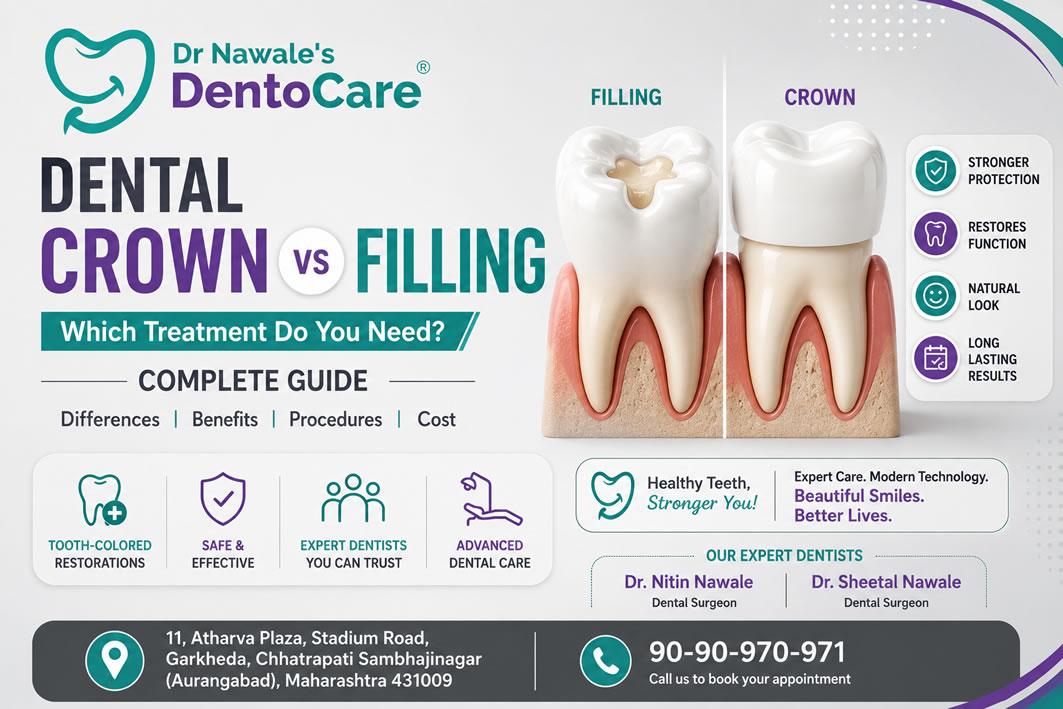
Dental Crown vs Filling — which one is right for your tooth? This is a common question when a tooth has decay, a large cavity, a fracture, an old restoration, or significant loss of tooth structure.
A dental filling is generally used to repair a cavity or restore a smaller area of lost tooth structure. A dental crown is a full-coverage restoration that fits over a prepared tooth and may be recommended when a tooth is significantly weakened, extensively damaged, or needs more protection.
However, the decision is not simply about the size of the cavity. Your dentist considers how much healthy tooth remains, the location of the tooth, biting forces, cracks or fractures, previous restorations, whether root canal treatment was performed, and the tooth’s overall ability to be restored.
If you are looking for a dental crown or filling in Chhatrapati Sambhajinagar, the dental team at Dr Nawale’s DentoCare in Garkheda can evaluate your tooth and explain which restoration is appropriate for your individual condition.
Table of content
- Dental Crown vs Filling: Quick Answer
- What Is a Dental Filling?
- What Is a Dental Crown?
- Dental Crown vs Filling: Key Differences
- When Do You Need a Dental Filling?
- When Do You Need a Dental Crown?
- Crown vs Filling: How Dentists Decide
- Dental Crown vs Filling Comparison Table
- Does a Crown Mean the Tooth Is More Damaged?
- Can a Large Cavity Be Treated With a Filling?
- Why a Tooth May Need a Crown After Root Canal Treatment
- Dental Crown Procedure
- Dental Filling Procedure
- Crown vs Filling: Which Is More Expensive?
- Does Getting a Crown or Filling Hurt?
- How Long Do Dental Crowns and Fillings Last?
- Crown vs Filling: Advantages and Limitations
- Dental Crown vs Filling Infographic
- Common Mistakes Patients Make
- Why Choose Dr Nawale’s DentoCare?
- Expert Dental Team in Chhatrapati Sambhajinagar
- Dr. Nitin Nawale
- Dr. Sheetal Nawale
- Frequently Asked Questions
- Final Takeaway
Dental Crown vs Filling: Quick Answer
A filling may be appropriate when:
- The cavity is relatively limited
- Enough healthy tooth structure remains
- The tooth does not require full-coverage protection
- The remaining tooth can support a direct restoration
A crown may be appropriate when:
- A large amount of tooth structure has been lost
- The tooth is significantly weakened
- A large existing filling has compromised the remaining tooth
- The tooth is cracked or fractured in a way that can be restored
- The tooth has undergone root canal treatment and needs appropriate restoration
- A full-coverage restoration is otherwise indicated
A filling is placed into the prepared area of the tooth, whereas a crown is fabricated to cover the tooth after it has been appropriately prepared.
The best treatment depends on the condition of your tooth—not simply on whether the cavity looks big or small.
What Is a Dental Filling?
A dental filling is a restoration used to repair a tooth after decay or loss of tooth structure.
During treatment, the dentist removes the unhealthy tooth structure as appropriate, prepares the area and restores it with a suitable filling material.
Common restorative materials include:
- Tooth-colored composite resin
- Glass ionomer-based materials in selected situations
- Other restorative materials based on the clinical requirement
Direct restorative materials are generally placed directly into the prepared tooth, and composite resin is commonly used when a tooth-colored restoration is desired.
Example
A patient has a cavity affecting one or a few surfaces of a tooth, with sufficient healthy tooth structure remaining.
The dentist may determine that a filling provides an appropriate way to restore the tooth.
What Is a Dental Crown?
AA dental crown is a fixed restoration that fits over a prepared tooth.
It is sometimes called a dental cap.
A crown can help restore:
- Tooth shape
- Tooth function
- Appearance
- Structural support
Crowns may be considered for teeth that have been significantly weakened by decay, large restorations, fractures, wear or other damage.
Different crown materials are available, including ceramic-based and metal-based options. The appropriate material depends on factors such as tooth location, functional requirements, aesthetics and the dentist’s treatment plan.
Dental Crown vs Filling: Key Differences
The simplest way to understand the difference is:
A filling repairs a specific damaged area of a tooth, while a crown covers the tooth to provide broader restoration and protection.
Think of it this way:
Small-to-moderate loss of tooth structure
→ Filling may be suitable
Extensive loss or weakened tooth
→ Crown may be considered
But this is only a general guide.
A dentist must examine the tooth before deciding.
When Do You Need a Dental Filling?
A filling may be considered when tooth decay has created a cavity but enough healthy tooth structure remains.
Common situations include:
1. Small or moderate cavities
A filling can replace the tooth structure lost due to decay.
2. Tooth-colored restoration
Composite resin can be used when an aesthetic, tooth-colored restoration is appropriate.
3. Limited tooth damage
If the remaining tooth structure is sufficiently strong, full coverage may not be necessary.
4. Replacement of an old filling
An existing filling may sometimes need to be replaced because of wear, leakage, fracture or recurrent decay.
The decision depends on the clinical condition rather than simply the age of the filling.
When Do You Need a Dental Crown?
A crown may be recommended when a tooth requires more extensive restoration or protection.
Common situations include:
Large Cavity
If decay has removed a significant amount of tooth structure, a simple filling may not provide the desired structural restoration.
Large Existing Filling
A tooth with a very large filling may have less remaining healthy structure and may require a different restorative approach. Crowns can sometimes be used to restore teeth weakened by large fillings.
Cracked or Broken Tooth
A damaged tooth may require full-coverage restoration depending on the location and extent of the fracture.
Heavily Worn Tooth
Significant tooth wear can alter tooth shape and function and may require restorative treatment.
After Root Canal Treatment
A root-filled tooth may require an appropriate final restoration depending on how much tooth structure remains and the tooth’s functional requirements.
Crown vs Filling: How Does a Dentist Decide?
This is where professional examination becomes important.
Your dentist may assess:
1. How much tooth structure remains
The more healthy tooth structure that remains, the more restorative options may be available.
2. Location of the tooth
Front teeth and back teeth experience different functional and aesthetic demands.
3. Size of the restoration
A small filling and a very large filling don’t place the same demands on the remaining tooth.
4. Cracks or fractures
The presence, location and extent of a crack can significantly affect treatment planning.
5. Previous treatment
A tooth that has previously undergone root canal treatment may have different restorative requirements.
6. Bite forces
Your dentist may consider how strongly the tooth is loaded during chewing.
7. Oral hygiene and caries risk
The likelihood of future decay is also relevant when planning restorative care.
8. Aesthetic requirements
For visible teeth, appearance and shade matching may influence the restoration selected.
Dental Crown vs Filling Comparison Table
| Feature | Dental Filling | Dental Crown |
|---|---|---|
| Main purpose | Repair localized tooth damage | Restore and cover a weakened tooth |
| Coverage | Usually limited to damaged area | Covers the prepared tooth |
| Common use | Cavities and limited tooth damage | Extensive damage or weakened teeth |
| Tooth preparation | Removes decay and prepares the affected area | Tooth is reshaped to accommodate the crown |
| Material options | Composite and other restorative materials | Ceramic, metal, porcelain-fused-to-metal and other options |
| Tooth structure remaining | Usually adequate healthy structure remains | May be recommended when more structure has been lost |
| Procedure | Often completed directly in the mouth | Usually requires tooth preparation and crown fabrication |
| Aesthetic options | Tooth-colored fillings available | Tooth-colored crown options available |
| Root canal connection | Not necessarily required | May be used as the final restoration in selected root-filled teeth |
| Best choice | Depends on tooth condition | Depends on tooth condition |
Does a Crown Mean the Tooth Is More Damaged?
Not necessarily.
A crown is not automatically a sign that a tooth is “bad.”
It means the dentist believes the tooth may benefit from a restoration that provides broader coverage.
For example, a tooth could have:
- A large old filling
- Extensive loss of tooth structure
- A fracture
- Significant wear
- A previous root canal
In such situations, a crown may be considered to restore the tooth.
Can a Large Cavity Be Treated With a Filling?
CSometimes, yes—but not every large cavity should automatically receive a filling.
The key question is:
Is enough healthy tooth structure remaining to support the planned restoration?
If substantial tooth structure has been lost, your dentist may recommend a crown or another restorative option instead.
A direct filling can be appropriate for many cavities, but the extent and location of the lesion, remaining tooth structure, functional demands and other clinical factors matter.
Why Might a Tooth Need a Crown After Root Canal Treatment?
Root canal treatment addresses the diseased pulp inside the tooth. It does not automatically mean every treated tooth must receive exactly the same type of restoration.
After RCT, the dentist evaluates the remaining tooth structure and determines the appropriate final restoration.
A crown may be recommended when the tooth has significant structural loss or requires additional protection.
The important sequence is:
Dental infection / pulp problem
↓
Root canal treatment when indicated
↓
Tooth cleaned and sealed
↓
Assessment of remaining tooth structure
↓
Appropriate final restoration
↓
Restored tooth function
A root-filled tooth with significant structural loss may be weakened and may require a crown or another suitable restoration depending on the clinical situation.
Dental Crown Procedure
The exact procedure varies according to the tooth and type of crown.
Generally, treatment involves:
Step 1: Dental Examination
Your dentist evaluates the tooth and determines whether a crown is appropriate.
Step 2: Treatment Planning
The dentist considers:
- Tooth condition
- Remaining structure
- Bite
- Aesthetics
- Crown material
Step 3: Tooth Preparation
The tooth is reshaped to create space for the crown.
Step 4: Impression or Digital Scan
The prepared tooth may be recorded using a conventional impression or digital scanning technology, depending on the clinic’s workflow.
Step 5: Temporary Restoration
In some treatment workflows, a temporary crown may be provided while the final crown is being prepared.
Step 6: Final Crown
The final crown is checked for fit, appearance and bite before being permanently fixed according to the treatment plan.
Dental Filling Procedure
A typical filling procedure may involve:
Examination
The dentist identifies the cavity or damaged area.
↓
Local Anesthesia
Anesthetic may be used when required for patient comfort.
↓
Removal of Decayed Tooth Structure
The affected tooth structure is removed as appropriate.
↓
Tooth Preparation
The area is prepared for restoration.
↓
Filling Material
The selected restorative material is placed.
↓
Shaping & Finishing
The filling is shaped and polished.
↓
Bite Check
The dentist checks that your bite feels comfortable.
Direct restorations are placed directly into the prepared tooth, unlike many indirect restorations that are fabricated outside the mouth before placement.
Dental Crown vs Filling: Which Is More Expensive?
There is no single fixed price for either treatment.
The cost can vary depending on:
- Tooth location
- Amount of damage
- Material selected
- Complexity of treatment
- Whether root canal treatment is required
- Laboratory charges
- Additional procedures
- Type of final restoration
A crown generally involves more treatment steps and laboratory or fabrication processes than a straightforward direct filling, so the cost can be higher.
However, choosing treatment only on price is not advisable.
A filling may be less expensive initially, but if a tooth genuinely requires broader structural protection, your dentist may recommend a crown or another appropriate restoration.
Does Getting a Crown or Filling Hurt?
Both treatments can generally be performed with local anesthesia when necessary.
Filling
You may feel:
- Pressure
- Vibration
- Water spray
- Instrument movement
Crown
During tooth preparation, local anesthesia may be used to keep the procedure comfortable.
After treatment, some temporary sensitivity can occur depending on the tooth and procedure.
If you experience persistent or severe pain after a restoration, contact your dentist for an evaluation.
How Long Do Dental Crowns and Fillings Last?
There is no guaranteed lifespan for a dental restoration.
Longevity depends on factors such as:
- Material
- Tooth location
- Size of restoration
- Bite forces
- Oral hygiene
- Diet
- Grinding or clenching
- Quality of the restoration
- Regular dental checkups
A filling can remain functional for years, but some fillings may eventually need repair or replacement.
Crowns can also last for many years, but they are not permanent for life.
The most important point:
Good oral hygiene and regular dental examinations can help identify problems early and protect your restoration.
Dental Crown vs Filling: Advantages & Limitations
Dental Filling
Advantages
- Conservative restoration for appropriate cavities
- Can often be completed directly in the mouth
- Tooth-colored composite options are available
- Useful for repairing localized tooth damage
- Generally requires less extensive tooth preparation than a crown
Limitations
- May not be appropriate when too much tooth structure has been lost
- Large restorations can present different functional challenges
- May eventually need repair or replacement
Dental Crown
Advantages
- Provides full coverage of the prepared tooth
- Can restore shape and function
- Useful for selected weakened or extensively damaged teeth
- Tooth-colored options can provide an aesthetic result
- Can be used in selected root-treated teeth when appropriate
Limitations
- Requires preparation of the tooth
- Usually involves more treatment steps
- Higher cost than many direct fillings
- Not every damaged tooth requires a crown
Dental Crown vs Filling Infographic
🦷 CROWN OR FILLING — WHICH ONE DO YOU NEED?
STEP 1
Tooth has decay or damage
⬇️
STEP 2
Dentist examines the tooth
🦷 Clinical examination
🩻 Imaging when required
⬇️
STEP 3
How much healthy tooth remains?
🟢 Enough tooth structure
FILLING MAY BE SUITABLE
✔ Repairs localized damage
✔ Direct restoration
✔ Tooth-colored options available
⬇️
🔵 Tooth significantly weakened
CROWN MAY BE CONSIDERED
✔ Covers the prepared tooth
✔ Restores shape and function
✔ Provides broader coverage
⬇️
FINAL DECISION
Your dentist selects the restoration based on:
🦷 Remaining tooth structure
📍 Tooth location
💪 Functional forces
🔨 Cracks/fractures
🩺 Previous treatment
✨ Aesthetic requirements
KEY MESSAGE
A filling repairs a damaged area. A crown covers and restores a weakened tooth. The right treatment depends on your individual tooth condition.
Crown vs Filling: Simple Decision Guide
| If your tooth has… | Possible treatment |
|---|---|
| Small cavity | Filling may be appropriate |
| Moderate cavity with adequate tooth structure | Filling may be appropriate |
| Very large restoration needed | Crown may be considered |
| Significant structural loss | Crown may be considered |
| Major fracture | Crown or another treatment depending on restorability |
| Root canal-treated tooth | Appropriate final restoration based on remaining structure |
| Tooth that cannot be restored predictably | Other treatment options may need consideration |
This table is a general guide—not a diagnosis.
Only a dental examination can determine the appropriate treatment.
Common Mistakes Patients Make
Mistake 1: Choosing a filling simply because it is cheaper
The cheapest treatment is not always the most appropriate treatment.
Mistake 2: Assuming every large cavity needs a crown
The decision depends on the remaining tooth structure and other clinical factors.
Mistake 3: Ignoring a cracked tooth
A crack can worsen and should be evaluated.
Mistake 4: Delaying treatment
A small cavity can become more extensive if untreated.
Mistake 5: Thinking a crown lasts forever
Crowns can wear, fracture, become loose or develop problems around them.
Mistake 6: Ignoring oral hygiene after treatment
A restored tooth can still develop decay around or near the restoration.
Mistake 7: Choosing restoration without understanding the diagnosis
Ask your dentist:
Why do I need a filling instead of a crown?
or:
Why do I need a crown instead of a filling?
A good dentist should explain the reasoning behind the treatment plan.
Why Choose Dr Nawale’s DentoCare?
For patients searching for dental crowns and fillings in Chhatrapati Sambhajinagar, choosing the right dental clinic is about more than the restoration itself.
At Dr Nawale’s DentoCare, the treatment approach focuses on diagnosis, treatment planning, appropriate restoration and long-term oral health.
The clinic provides comprehensive dental care in Garkheda, Chhatrapati Sambhajinagar, with services including restorative dentistry, root canal treatment, dental crowns and bridges, dental implants, pediatric dentistry, orthodontics and cosmetic dentistry.
The clinic’s listed address is 11, Atharva Plaza, Stadium Road, Garkheda, Chhatrapati Sambhajinagar, Maharashtra 431009, with phone number +91 9090970971.
Modern Dental Technology
Dr Nawale’s DentoCare also uses modern dental equipment, including:
- Digital Intraoral Scanner
- Advanced Portable X-ray
- OPG X-ray
Digital scanning can be useful for selected restorative and digital dental workflows, while dental imaging can assist diagnosis and treatment planning when clinically indicated.
Expert Dental Team in Chhatrapati Sambhajinagar
Dr. Nitin Nawale
Dr. Nitin Nawale is part of the dental team at Dr Nawale’s DentoCare, Garkheda, Chhatrapati Sambhajinagar.
Patients with damaged, decayed, broken or heavily restored teeth can consult the dental team for evaluation and treatment planning.
A crown or filling should be recommended based on the condition of the tooth rather than simply on the patient’s preference.
Dental concerns that may require evaluation include:
- Tooth decay
- Large cavities
- Broken teeth
- Cracked teeth
- Old or damaged fillings
- Tooth sensitivity
- Pain while chewing
- Worn teeth
- Root canal-treated teeth requiring final restoration
Dr. Sheetal Nawale
Dr. Sheetal Nawale is also part of the dental team at Dr Nawale’s DentoCare.
Children can develop cavities that require restorative treatment. The appropriate restoration for a child depends on factors such as the child’s age, the affected tooth, extent of decay, caries risk and expected time before the tooth naturally exfoliates.
For children’s dental problems, early evaluation can help prevent small cavities from progressing into more complicated problems.
When Should You Visit a Dentist for a Crown or Filling?
Don’t wait until the tooth becomes severely painful.
Schedule a dental examination if you notice:
🦷 A visible cavity
A visible hole or dark area may indicate decay.
⚡ Tooth sensitivity
Sensitivity to hot, cold or sweet foods can have several causes and should be evaluated when persistent.
🍎 Pain while chewing
Pain on biting can occur with different dental conditions, including decay, cracks or problems involving the tooth’s supporting structures.
🧩 Broken tooth
A broken portion of a tooth should be evaluated promptly.
🔨 Cracked tooth
Cracks can potentially worsen depending on their location and extent.
🪥 Old filling falling out
A lost or broken filling requires dental assessment rather than simply being ignored.
Frequently Asked Questions (FAQ)
Is a crown better than a filling?
Not necessarily. A crown and filling serve different purposes. A filling may be appropriate when enough healthy tooth structure remains, while a crown may be considered when a tooth is significantly weakened or requires broader coverage.
Which is cheaper, a filling or crown?
A filling is generally less expensive than a crown, but the cost varies depending on the material, tooth and complexity of treatment. The appropriate treatment should be selected based on the condition of the tooth rather than price alone.
Can a large cavity be filled instead of crowned?
Sometimes. If sufficient healthy tooth structure remains, a filling may be appropriate. If the tooth is significantly weakened, your dentist may recommend a crown or another restoration.
Does a crown hurt?
The tooth is usually prepared under appropriate anesthesia when needed. Some temporary sensitivity or gum soreness may occur afterward.
Does a filling hurt?
A filling can generally be performed comfortably with local anesthesia when required. You may feel pressure or vibration during the procedure.
Do all root canal-treated teeth need crowns?
Not necessarily. The appropriate final restoration depends on the tooth, remaining structure, location, function and other clinical factors.
How do I know whether I need a crown or filling?
Your dentist will examine the tooth and consider the amount of remaining tooth structure, decay, cracks, previous restorations, bite forces and other factors.
Can a crown prevent a tooth from breaking?
A crown provides coverage and may help restore and protect a weakened tooth when appropriately indicated. However, no restoration can guarantee that a tooth will never fracture.
Can a filling fall out?
Yes. Fillings can become damaged, worn or dislodged. If a filling falls out, arrange a dental examination rather than trying to permanently repair it yourself.
How long does a dental filling last?
There is no universal lifespan. It depends on the material, size and location of the filling, biting forces, oral hygiene and other factors.
How long does a dental crown last?
Crowns can function for many years, but their lifespan varies according to material, oral hygiene, bite forces, tooth condition and maintenance.
Can I get a crown without a root canal?
Yes. A crown does not automatically require root canal treatment. A crown may be placed on a tooth with a healthy pulp when full coverage is clinically appropriate.
Can a filling be replaced with a crown later?
In some cases, yes. If a tooth with a filling becomes significantly weakened or develops other problems, your dentist may reassess it and recommend a crown or another treatment.
What happens if I don’t treat a cavity?
Untreated decay can progress deeper into the tooth and may eventually affect the pulp, potentially requiring more extensive treatment.
Where can I get dental crowns and fillings in Chhatrapati Sambhajinagar?
You can consult Dr Nawale’s DentoCare in Garkheda, Chhatrapati Sambhajinagar, for evaluation of cavities, damaged teeth and restorative treatment options. The clinic is located at 11, Atharva Plaza, Stadium Road, Garkheda.
Where can I get digital intraoral scanning in Chhatrapati Sambhajinagar?
Patients looking for digital intraoral scanning in Chhatrapati Sambhajinagar (Aurangabad) can consult Dr Nawale’s DentoCare to determine whether digital scanning is appropriate for their dental treatment.
Final Takeaway: Crown or Filling?
There is no universal answer to “Is a dental crown better than a filling?”
The correct question is:
Which restoration is appropriate for my particular tooth?
Remember:
Filling = repairs a localized area of tooth damage
Crown = covers and restores a significantly weakened or extensively damaged tooth when indicated
A dentist may consider the amount of remaining tooth structure, size and location of decay, cracks, previous restorations, bite forces and overall tooth condition before recommending treatment.
If you have a cavity, broken filling, cracked tooth, sensitivity or a damaged tooth, don’t wait for the problem to become painful.
Early dental evaluation can help you understand whether a filling, crown or another treatment is appropriate.
Looking for the Best Dental Clinic in Chhatrapati Sambhajinagar?
Many patients from:
- Garkheda
- Kasliwal Nagar
- Beed Bypass
- CIDCO
- Jalna Road
- Samarth Nagar
- Ulkanagari
- Bajaj Nagar
- Seven Hills
- Usmanpura
visit Dr Nawale’s DentoCare for comprehensive dental care. The clinic is located at Stadium Road, Garkheda, Chhatrapati Sambhajinagar.
Looking for Dental Crown or Filling Treatment in Chhatrapati Sambhajinagar?
Dr Nawale’s DentoCare
📍 11, Atharva Plaza, Stadium Road, Garkheda, Chhatrapati Sambhajinagar (Aurangabad)
📞 90-90-970-971