
Tooth Replacement Options at Dr Nawale's DentoCare
Missing teeth can affect chewing, speech, confidence and the ability to enjoy everyday foods. Depending on the number of missing teeth and the condition of your remaining teeth and gums, several tooth-replacement options may be available.
Dr Nawale's DentoCare provides dental consultations in Garkheda, Chhatrapati Sambhajinagar (Aurangabad), for patients exploring dental implants and other restorative solutions.
A dental implant is a small, usually titanium-based fixture placed in the jawbone to support a dental restoration, such as a crown, bridge or denture. It acts as an artificial tooth root and may be considered for replacing one or more missing teeth.
Whether you have lost a single tooth, several teeth or most of your teeth, the appropriate treatment depends on a clinical examination, gum health, bone support, medical history and individual treatment goals.
Looking for dental implant treatment in Chhatrapati Sambhajinagar?
- Call: +91 90909 70971
- Email: info@drnawaledentocare.com
- Location: 11, Atharva Plaza, Stadium Road, Garkheda, Chhatrapati Sambhajinagar, Maharashtra – 431009
- Clinic hours: Monday–Saturday, 10:00 AM–8:00 PM
What Are Dental Implants?
A dental implant is a fixture placed in the jawbone to support a replacement tooth or teeth. After placement, the implant may gradually integrate with the surrounding bone through a process called osseointegration.
Once the implant site has healed sufficiently, a suitable restoration may be attached. This may be a single crown, a bridge or a denture supported by implants, depending on the treatment plan.
Dental implants are different from conventional bridges and removable dentures because the implant provides support from within the jawbone rather than relying only on neighbouring teeth or the gums.
Implants are not suitable for everyone, and they do not guarantee a lifetime result. Careful planning, appropriate treatment, daily cleaning and regular professional follow-up are important for long-term maintenance.
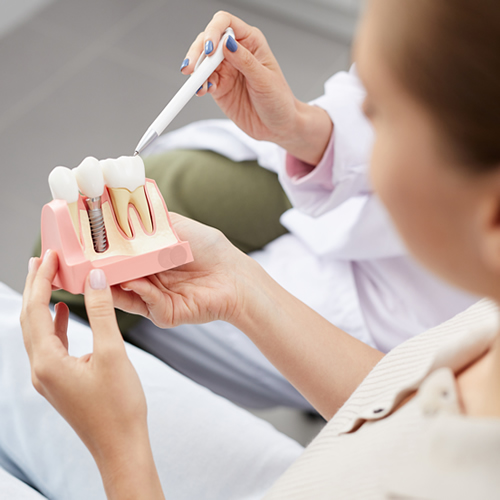
WHAT ARE DENTAL IMPLANTS?
A dental implant is a titanium object which is placed in the jaw at the site of the missing teeth. It is bio compatible totally and doesn't cause any harm to the jaw bone. It acts as an artificial tooth root. It is attached to bone through osseointegration. Once the implant is fully integrated into the jaw bone, the crown is placed on it.
Who May Consider Dental Implants?
Dental implants may be an option for adults who have lost teeth because of decay, gum disease, trauma or other dental conditions.
An implant consultation may be useful if you:
- Have one missing tooth and want to explore replacement options.
- Have multiple missing teeth that affect chewing.
- Find a removable denture uncomfortable or unstable.
- Need to replace a tooth that cannot be restored.
- Want to understand the differences between implants, bridges and dentures.
- Are exploring implant-supported solutions for extensive tooth loss.
The dentist must assess whether implant treatment is appropriate for your specific circumstances. Factors such as active gum disease, smoking, uncontrolled medical conditions, certain medications and insufficient bone may affect the timing, suitability and expected outcome of treatment.
Types of Dental Implant Treatment
1. Single Tooth Dental Implant
A single tooth implant may be considered when one tooth is missing or cannot be preserved. The implant supports an individual crown designed to restore the missing tooth's appearance and function.
In suitable cases, an implant-supported crown can replace the tooth without requiring the adjacent teeth to be prepared as bridge supports.
2. Multiple Teeth Replacement
When several teeth are missing, implant treatment may involve more than one implant supporting individual crowns or a bridge. The number and placement of implants depend on the available bone, the position of the missing teeth, bite forces and the proposed restoration.
A clinical examination and appropriate imaging help the dentist determine which options may be suitable.
3. Full-Arch or Full-Mouth Implant-Supported Teeth
Patients who have lost most or all teeth in an arch may be able to consider an implant-supported full-arch restoration or an implant-supported denture.
These treatments require detailed assessment of the jawbone, bite, gum health, medical history and restorative requirements. Not every patient is suitable for the same implant configuration, and the number of implants needed varies.
4. Implant-Supported Dentures
An implant-supported denture uses dental implants to improve the support or stability of a removable or fixed prosthetic restoration, depending on the design.
This may be considered for selected patients who have difficulty with a conventional denture. The dentist will explain the maintenance requirements, attachment system, cleaning method and likely treatment stages before a decision is made.
5. Immediate or Early Implant Restoration
In selected cases, a temporary restoration may be attached soon after implant placement. This is sometimes described as immediate loading or early loading.
It is not appropriate for every patient. The decision depends on factors such as implant stability, bone quality, bite forces, the location of the implant and the overall treatment plan.
Do not assume that an implant can always receive a permanent tooth on the same day. The treating dentist must determine the appropriate loading and healing schedule.
What Are the Benefits of Dental Implants?
When suitable and properly maintained, dental implants may offer several benefits:
- Replacement of missing teeth: Implants can support restorations for one or multiple missing teeth.
- Support for chewing: A well-planned restoration may help restore chewing function.
- No need to prepare adjacent teeth in some cases: A single implant-supported crown may avoid the need to shape neighbouring teeth as bridge supports.
- Support for prosthetic restorations: Implants can be used with crowns, bridges or selected denture designs.
- Natural-looking appearance: The visible restoration can be designed to complement surrounding teeth.
- Jawbone support: Implant placement can help maintain bone in the treated area, although it does not prevent all bone changes.
- Long-term treatment option: Implants may function for many years, but the implant and its restoration require ongoing care and may need maintenance or repair.
The benefits vary from person to person. An implant is not automatically better than a bridge or denture for every clinical situation.
Dental Implants vs Dental Bridges vs Dentures
The most appropriate option depends on the condition of your mouth, the number of missing teeth, your budget and your preferences.
| Feature | Dental implants | Dental bridges | Removable dentures |
|---|---|---|---|
| Main support | Implant fixture in the jawbone | Adjacent teeth or other suitable supports | Gums and oral tissues, or implant attachments |
| Surgery | Usually required for implant placement | Usually not required for a conventional bridge | Usually not required for conventional dentures |
| Adjacent teeth | May avoid preparing neighbouring teeth for a single-tooth replacement | Supporting teeth may need preparation | Usually does not require preparation of neighbouring teeth |
| Maintenance | Daily cleaning and regular dental reviews | Cleaning beneath and around the bridge | Daily cleaning and periodic adjustment or replacement |
| Suitability | Depends on bone, gums, health and other factors | Depends on supporting teeth and the gap | Depends on oral anatomy and the type of denture |
Dental Implant Treatment Procedure: Step by Step
The implant process varies according to the patient's condition and the complexity of the restoration. A typical treatment pathway may include the following stages.
Step 1: Initial Consultation
The dentist discusses your concerns, missing teeth, medical history, medications, smoking history, previous dental treatment and expectations.
An examination of your teeth, gums and bite helps determine whether further investigations are needed.
Step 2: Diagnostic Assessment and Treatment Planning
Dental imaging, including X-rays or a CBCT scan, may be recommended when clinically appropriate. These investigations can help assess bone dimensions, nearby anatomical structures and implant positioning.
The dentist will explain the proposed treatment, alternatives, possible risks, estimated timeline and expected costs.
Step 3: Preparation Before Implant Placement
If you have active gum disease, untreated decay or other oral health concerns, these may need to be managed before implant placement.
Some patients may require additional procedures, such as bone grafting, depending on the available bone and treatment requirements. These procedures are not necessary for everyone.
Step 4: Implant Placement
Implant placement is a surgical procedure generally performed using local anaesthesia. The implant is placed in the planned position within the jawbone.
The procedure, duration and recovery depend on the number of implants, their location and whether additional treatment is required.
Step 5: Healing and Integration
The implant needs time to heal and integrate with the surrounding bone. The duration varies depending on the patient's healing, bone quality, implant location and treatment plan.
A temporary tooth or restoration may be possible in selected cases, but it is not guaranteed.
Step 6: Attaching the Final Restoration
When the implant site is ready, the dentist or restorative team arranges the appropriate crown, bridge or denture. The restoration is checked for fit, appearance, bite and function.
Step 7: Regular Follow-up and Maintenance
After treatment, you will need to maintain excellent oral hygiene and attend regular dental reviews. The dentist will advise you about cleaning around the implant, professional maintenance and signs that require attention.
Are Dental Implants Painful?
Implant placement is usually carried out under local anaesthesia to numb the treatment area. You may feel pressure during the procedure, and some discomfort, swelling or bruising can occur afterwards.
The amount of discomfort varies depending on the extent of surgery and the individual patient's response. Follow the treating dentist's instructions for medicines, food, oral hygiene and recovery.
If pain or swelling becomes severe, increases instead of improving, or is accompanied by fever or other concerning symptoms, contact your dental provider promptly.
No responsible clinician can guarantee a completely pain-free procedure or recovery for every patient.
How Long Does Dental Implant Treatment Take?
Dental implant treatment may take several months from initial planning to the final restoration. The actual duration depends on the need for tooth extraction, bone grafting, healing, implant stability and the type of restoration.
Some selected cases can be completed using an accelerated protocol, while others require additional healing time before the final tooth can be attached.
The dentist will provide a more realistic timeline after examining your mouth and reviewing the necessary diagnostic information.
Are Dental Implants Suitable for Everyone?
No. Dental implants are not suitable for every patient or every missing-tooth situation.
Your dentist may consider:
- The quantity and quality of available jawbone
- Gum health and control of periodontal disease
- Existing tooth decay or oral infections
- General health and healing capacity
- Diabetes control and other relevant medical conditions
- Smoking or tobacco use
- Certain medications and medical treatments
- Teeth grinding, bite forces and oral hygiene
- Your ability to attend follow-up appointments and maintain the restoration
Age alone does not determine suitability. A comprehensive evaluation is needed to assess whether implant treatment is appropriate and whether any preparation is required first.
Risks and Possible Complications of Dental Implants
Like other surgical treatments, dental implant placement carries potential risks. These may include pain, swelling, bleeding, infection, delayed healing, failure of the implant to integrate with the bone, or damage to nearby anatomical structures.
Longer-term complications can include inflammation around the implant, bone loss, loosening or damage to the restoration and the need for further treatment.
Smoking, poor oral hygiene, uncontrolled gum disease and some health-related factors may increase the risk of complications.
Your dentist should explain the risks relevant to your medical and dental history and discuss alternative options before you consent to treatment.
How to Care for Dental Implants After Treatment
Good home care and regular follow-up are essential for maintaining implant health.
- Brush twice daily using a suitable toothbrush and fluoride toothpaste for your remaining natural teeth.
- Clean carefully around the implant and beneath implant-supported restorations using the method recommended by your dentist.
- Use interdental brushes, floss or other cleaning aids as instructed.
- Avoid smoking and tobacco; ask for support if you need help stopping.
- Attend regular dental check-ups and professional maintenance appointments.
- Follow post-operative instructions regarding food, medicines, activity and oral hygiene.
- Contact the dentist if you notice persistent bleeding, swelling, pain, pus, loosening or changes in how your teeth fit together.
Dental implants cannot develop decay in the same way as natural teeth, but the surrounding tissues can become inflamed or infected. They still require daily cleaning and professional monitoring.
Dental Implant Cost in Chhatrapati Sambhajinagar
The cost of dental implants depends on the treatment required for each patient. There is no single price that applies to every implant case.
Factors that may affect the total cost include:
- Number of implants required
- Implant system and components used
- Type and material of the crown, bridge or denture
- Diagnostic imaging and treatment planning
- Tooth extraction or other preparatory procedures
- Bone grafting or other additional surgery, if needed
- Temporary restorations and follow-up care
For an accurate estimate, contact Dr Nawale's DentoCare and request a consultation. Ask for a written treatment plan that identifies the implant, abutment, crown or prosthesis, imaging, additional procedures and follow-up charges, as applicable.
Meet the Dentists at Dr Nawale's DentoCare
Dental implant treatment requires an appropriate assessment, surgical planning and restoration planning. Dr Nawale's DentoCare lists Dr. Nitin Nawale and Dr. Sheetal Nawale among its dental team. The treating dentist and any specialist involvement should be confirmed according to the clinical requirements of your case.
Dr. Nitin Nawale — BDS, Dental Surgeon, Fellowship in Endodontics
Dr. Nitin Nawale is a BDS-qualified Dental Surgeon with a Fellowship in Endodontics. His clinic profile lists more than 22 years of clinical experience and identifies dental implants and full-mouth rehabilitation among his clinical interests. His profile also notes additional certificate training in dental implants and full-mouth rehabilitation.
For patients considering implant-based tooth replacement, an individual assessment is necessary to evaluate the missing tooth or teeth, gum health, bone support and the most appropriate restorative plan.
View his profile: Dr. Nitin Nawale – Dentist in Chhatrapati Sambhajinagar
Dr. Sheetal Nawale — BDS, Dental Surgeon, Fellowship in Restorative Paediatric Dentistry
Dr. Sheetal Nawale is a BDS-qualified Dental Surgeon whose profile lists a Fellowship in Restorative Paediatric Dentistry and dental practice since 2004. Her clinical interests include restorative and conservative dentistry, children's dental care, smile designing and orthodontic treatment.
Her profile is included here as part of the clinic's dental team. The clinic should confirm her role in an individual patient's implant consultation or treatment plan rather than assuming that every team member performs implant surgery.
View her profile: Dr. Sheetal Nawale – Dentist in Chhatrapati Sambhajinagar
Frequently Asked Questions About Dental Implants
1. Where can I get dental implants in Chhatrapati Sambhajinagar?
You can contact Dr Nawale's DentoCare at 11, Atharva Plaza, Stadium Road, Garkheda, Chhatrapati Sambhajinagar (Aurangabad), Maharashtra. The clinic can advise you about implant consultation availability and the appropriate treating dentist.
2. What is a dental implant?
A dental implant is a fixture placed in the jawbone to support a replacement tooth, bridge or denture. The final restoration and treatment stages depend on the patient's oral health and clinical requirements.
3. Are dental implants better than bridges or dentures?
Not in every case. Implants, bridges and dentures have different advantages, limitations, costs and maintenance needs. The best option depends on the condition of your teeth and gums, available bone, general health, preferences and budget.
4. Can a single missing tooth be replaced with a dental implant?
Yes, a single-tooth implant may be an option when the patient is suitable. The dentist must assess the site, neighbouring teeth, gum health and available bone before recommending treatment.
5. Can dental implants replace multiple missing teeth?
Yes. Depending on the number and location of missing teeth, implants may support individual crowns, a bridge or an implant-supported denture. The treatment design is determined after an individual assessment.
6. Can all missing teeth be replaced with dental implants?
Selected patients with extensive tooth loss may be suitable for implant-supported full-arch restorations or dentures. The number of implants and the type of restoration depend on bone support, general health, bite and other clinical factors.
7. How long does dental implant treatment take?
Treatment may take several months because the implant site needs to heal and integrate with the bone before the final restoration is attached. Some cases follow a faster protocol, but the timeline depends on the patient's condition and treatment plan.
8. Is dental implant surgery painful?
Local anaesthesia is generally used during implant placement. Some post-operative discomfort, swelling or bruising may occur, and the level of discomfort varies between patients and procedures. Your dentist will explain recovery expectations and aftercare.
9. What is the cost of dental implants in Chhatrapati Sambhajinagar?
The cost depends on the number of implants, the type of restoration, implant components, diagnostic tests and any additional procedures. Contact Dr Nawale's DentoCare for an individual assessment and an itemised estimate.
10. Can smokers get dental implants?
Smoking can impair healing and increase the risk of implant complications. Patients who smoke should discuss these risks with the dentist and seek advice about stopping before and after treatment.
11. Are dental implants suitable for people with diabetes?
Some people with diabetes may be suitable for implants, but diabetes control, healing capacity and other medical factors must be assessed. Inform the dentist about your medical history and medications before treatment.
12. Is bone grafting always required for dental implants?
No. Bone grafting may be considered when the available bone is insufficient for the planned implant, but it is not necessary in every case. Imaging and clinical assessment help determine whether additional procedures are required.
13. Can a dental implant get cavities?
The implant fixture itself does not develop tooth decay like natural enamel. However, the gums and bone around an implant can develop inflammatory problems, and the attached crown or other restoration may wear, loosen or become damaged. Daily cleaning and professional maintenance remain essential.
14. How long do dental implants last?
The lifespan varies according to the patient's health, bone and gum condition, oral hygiene, smoking status, bite forces and maintenance. Implants may function for many years, but the restoration may require repair or replacement. No specific lifespan can be guaranteed for every patient.
15. What should I do if my implant becomes loose or painful?
Contact your dentist promptly if the implant, crown or denture feels loose or you develop persistent pain, swelling, bleeding or pus. Avoid trying to tighten or repair the restoration yourself.
16. How do I book a dental implant consultation at Dr Nawale's DentoCare?
Call +91 90909 70971 or email info@drnawaledentocare.com to enquire about an appointment. The clinic is located at 11, Atharva Plaza, Stadium Road, Garkheda, Chhatrapati Sambhajinagar, Maharashtra – 431009. Listed opening hours are Monday–Saturday, 10:00 AM–8:00 PM.
Book a Dental Implant Consultation in Chhatrapati Sambhajinagar
If you have one or more missing teeth and want to explore dental implants, bridges or dentures, arrange a consultation at Dr Nawale's DentoCare. The dental team can assess your oral health, explain suitable options and help you understand the expected treatment stages, risks, maintenance and costs.
Dr Nawale's DentoCare
11, Atharva Plaza, Stadium Road, Garkheda, Chhatrapati Sambhajinagar, Maharashtra – 431009
Phone: +91 90909 70971
Email: info@drnawaledentocare.com
Hours: Monday–Saturday, 10:00 AM–8:00 PM
HOW CAN WE HELP?
Schedule Your Consultation
Booking an appointment with our team is convenient and easy.