
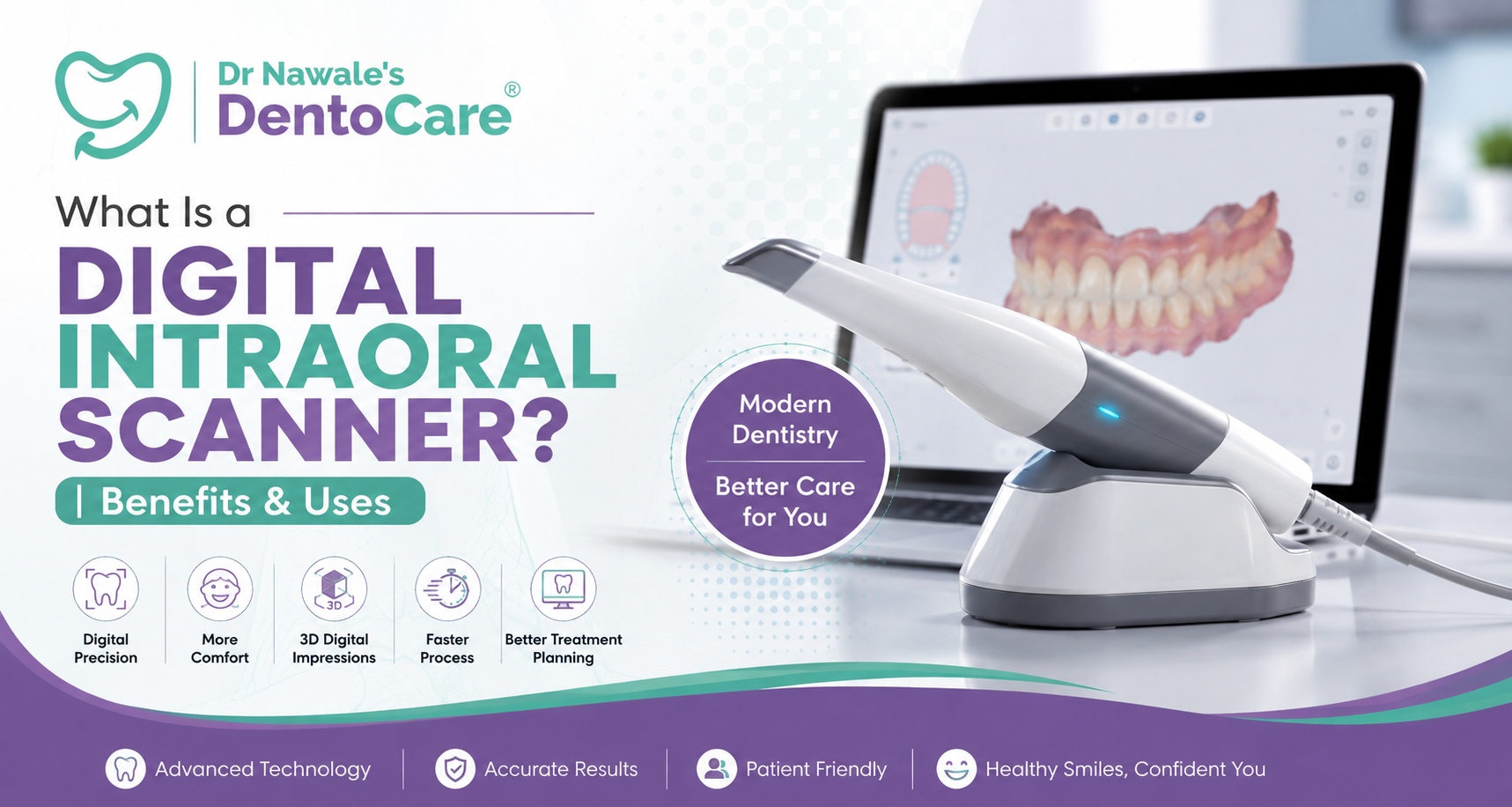
What Is a Digital Intraoral Scanner and Why Do Dentists Use It?
A digital intraoral scanner is an advanced dental device that captures highly detailed 3D images of the inside of your mouth, including your teeth and gums. Unlike traditional dental impressions that use trays and impression material, an intraoral scanner uses a small handheld camera-like device to create a digital model of your mouth.
Digital intraoral scanning is becoming an important part of modern dentistry because it can make dental examinations and treatments more comfortable, efficient and precise.
At Dr Nawale’s DentoCare in Chhatrapati Sambhajinagar (Aurangabad), modern dental technology is used along with clinical expertise to provide comfortable and patient-focused dental care.
Whether you need crowns, bridges, aligners, cosmetic dentistry or other restorative treatments, digital scanning can help your dentist understand your teeth in greater detail and plan treatment more effectively.
Table of content
- What Is a Digital Intraoral Scanner?
- How Does an Intraoral Scanner Work?
- What Does a Digital Intraoral Scanner Capture?
- Digital Intraoral Scanner vs Traditional Dental Impressions
- Why Do Dentists Use Intraoral Scanners?
- Benefits of Digital Intraoral Scanning for Patients
- Is Digital Intraoral Scanning Painful?
- How Accurate Is an Intraoral Scanner?
- Where Are Intraoral Scanners Used in Dentistry?
- Digital Scanning for Crowns and Bridges
- Digital Scanning for Clear Aligners and Braces
- Digital Scanning in Cosmetic Dentistry
- Digital Scanning for Dental Implants
- Digital Intraoral Scanner Procedure: Step by Step
- Who Can Benefit From an Intraoral Scan?
- Digital Dentistry at Dr Nawale’s DentoCare
- Why Choose Dr Nawale’s DentoCare in Chhatrapati Sambhajinagar?
- Meet the Expert Dentists
- Frequently Asked Questions
- Conclusion
What Is a Digital Intraoral Scanner?
A digital intraoral scanner is a specialized dental device used to capture detailed digital images of the teeth, gums and surrounding oral structures.
The dentist moves the small scanning wand around the patient’s mouth. The scanner captures multiple images and combines them using specialized software to create a 3D digital model of the patient’s teeth.
This digital model can then be used for diagnosis, treatment planning, dental restorations, orthodontic treatment and cosmetic dentistry.
Simple Definition
A digital intraoral scanner is a handheld dental scanning device that creates a detailed 3D digital model of your teeth and mouth without requiring traditional impression material.
In simple terms, instead of biting into a tray filled with impression material, your dentist can scan your teeth digitally.
How Does an Intraoral Scanner Work?
The process is relatively simple and usually takes only a few minutes, depending on the treatment and the area being scanned.
The basic process includes:
Scan → Capture → Process → Create 3D Model → Treatment Planning
The scanner uses an optical imaging system to capture numerous images as the dentist moves the scanner around the mouth.
The software then processes these images and generates a digital representation of the teeth.
Digital Intraoral Scanning Process
Step 1 – Dental Examination
Your dentist examines your teeth, gums and oral health.
↓
Step 2 – Scanning
A small handheld scanner is moved over the teeth.
↓
Step 3 – Image Capture
The scanner captures detailed images of the teeth and oral structures.
↓
Step 4 – Digital Processing
Specialized software combines the images into a 3D digital model.
↓
Step 5 – Treatment Planning
The dentist uses the digital model to evaluate the teeth and plan appropriate treatment.
What Does a Digital Intraoral Scanner Capture?
An intraoral scanner can capture detailed information about the visible surfaces of your teeth and surrounding oral structures.
Depending on the scanner and clinical application, it can help dentists evaluate:
- Tooth shape
- Tooth position
- Dental arches
- Bite relationship
- Tooth alignment
- Spaces between teeth
- Areas requiring restorations
- Gum contours
- Existing dental restorations
- Changes in tooth position
The resulting digital model can be viewed on a computer screen, allowing the dentist to examine the patient’s teeth from different angles.
Digital Intraoral Scanner vs Traditional Dental Impressions
Traditional impressions have been used in dentistry for many years. They involve placing a tray containing impression material inside the patient’s mouth and asking the patient to bite or hold it in position while the material sets.
Digital scanning provides an alternative approach for many dental procedures.
| Feature | Digital Intraoral Scanner | Traditional Impression |
|---|
| Method | Optical digital scanning | Physical impression material |
| Patient comfort | Generally more comfortable | May feel bulky |
| Gagging | Usually less likely | Can trigger gag reflex in some patients |
| Output | Digital 3D model | Physical dental model |
| Data storage | Digital | Physical model/material |
| Communication | Easy digital sharing | Requires physical model or impression |
| Treatment planning | Digital workflow | Conventional workflow |
| Patient visualization | Can view scan on screen | Usually cannot see the impression digitally |
Digital scanning does not replace every type of dental examination or diagnostic test. Your dentist decides which technology and diagnostic method is appropriate for your specific treatment.
Why Do Dentists Use Intraoral Scanners?
Dentists use intraoral scanners for several reasons.
1. Better Digital Visualization
A 3D digital model allows the dentist to view the patient’s teeth from different angles.
2. Patient Comfort
Many patients find digital scanning more comfortable than traditional impression procedures.
3. Efficient Digital Workflow
Digital scans can be transferred electronically to dental laboratories and treatment-planning systems when required.
4. Treatment Planning
The digital model can assist dentists in planning certain restorative, orthodontic and cosmetic procedures.
5. Patient Education
Dentists can show patients their teeth on a screen and explain areas that may require attention.
Benefits of Digital Intraoral Scanning for Patients
Digital intraoral scanning can offer several practical benefits.
🦷 Comfortable Experience
There is generally no need to fill a tray with traditional impression material.
📱 Digital 3D Visualization
Patients can often see a digital representation of their teeth and better understand their dental condition.
⚡ Efficient Workflow
Digital scans can streamline certain stages of treatment planning and laboratory communication.
🎯 Detailed Digital Records
The scan creates a digital record that can be useful for certain treatments and follow-up comparisons.
🤝 Better Patient Communication
Instead of simply explaining a dental problem verbally, the dentist can use the digital model to demonstrate tooth position, alignment and other findings.
💻 Digital Dentistry
Intraoral scanning is an important component of a modern digital dental workflow.
Is Digital Intraoral Scanning Painful?
No, digital intraoral scanning is generally a non-invasive and painless procedure.
The dentist gently moves the scanner inside your mouth to capture images of your teeth.
Unlike some traditional impression techniques, there is no need to place a tray filled with impression material over the entire dental arch.
However, patients may experience minor temporary discomfort if they have sensitive teeth, inflamed gums or difficulty keeping their mouth open. Your dentist can make the procedure as comfortable as possible.
How Accurate Is an Intraoral Scanner?
Modern intraoral scanners can produce highly detailed digital models suitable for many dental applications.
However, accuracy depends on several factors, including:
- Scanner technology
- Scanning technique
- Dentist’s experience
- Patient movement
- Saliva or moisture
- Area being scanned
- Clinical situation
- Software processing
For this reason, the scanner is a tool that works together with the dentist’s clinical examination and professional judgment.
A digital scan should not be considered a replacement for the dentist.
Where Are Intraoral Scanners Used in Dentistry?
Digital intraoral scanners can be useful in several areas of dentistry.
Common applications include:
Restorative Dentistry
- Crowns
- Bridges
- Certain dental restorations
Orthodontics
- Clear aligners
- Braces treatment planning
- Monitoring tooth movement
Cosmetic Dentistry
- Smile planning
- Veneers
- Esthetic restorations
Implant Dentistry
- Digital treatment planning and restorative workflows
Prosthodontics
- Dentures and other prosthetic treatment workflows
Digital Scanning for Crowns and Bridges
Crowns and bridges require accurate information about the teeth and surrounding structures.
A digital scan can provide the dentist and dental laboratory with a digital representation of the patient’s teeth.
This can help support the workflow for designing and manufacturing certain restorations.
Benefits can include:
- Digital transfer of dental information
- Improved communication with the dental laboratory
- Easy storage of digital records
- Patient-friendly scanning experience
- Digital treatment planning
Your dentist will determine whether digital scanning is appropriate for your specific crown or bridge treatment.
Digital Scanning for Clear Aligners and Braces
Digital scanning is particularly useful in modern orthodontic workflows.
Instead of taking a traditional impression, the dentist or orthodontist may create a digital model of the teeth.
This digital information can assist with:
- Evaluating tooth alignment
- Planning orthodontic treatment
- Designing clear aligners
- Monitoring treatment progress
- Showing patients their current tooth position
For patients considering clear aligners in Chhatrapati Sambhajinagar, digital scanning can make the initial assessment and treatment-planning process more convenient.
Digital Scanning in Cosmetic Dentistry
Cosmetic dentistry focuses on improving the appearance of your smile while maintaining appropriate dental function and health.
Digital scanning may be used as part of treatment planning for procedures such as:
- Veneers
- Crowns
- Smile makeovers
- Tooth reshaping
- Cosmetic restorations
A digital model can help dentists evaluate tooth proportions, alignment and other aspects of the smile before proceeding with treatment.
Digital Scanning for Dental Implants
Dental implants require careful diagnosis and treatment planning.
Digital intraoral scanning may be incorporated into the restorative and digital planning workflow for implant treatment.
Depending on the case, digital information may be combined with other diagnostic records such as dental X-rays or 3D imaging.
Important:
An intraoral scanner alone does not provide all the information needed to plan every dental implant case.
Your dentist determines which diagnostic tests are required based on your individual dental condition.
Digital Intraoral Scanner Procedure: Step by Step
Wondering what happens during a digital scan?
Step 1: Dental Examination
The dentist examines your mouth and identifies the purpose of the scan.
Step 2: Preparation
The teeth are prepared for scanning according to the clinical requirement.
Step 3: Scanning
The dentist gently moves the scanning wand over the teeth.
Step 4: Real-Time Image Capture
The scanner captures multiple images.
Step 5: 3D Model Creation
The software processes the images into a digital 3D model.
Step 6: Review
The dentist reviews the digital model and identifies the information needed for treatment.
Step 7: Treatment Planning
The scan can then become part of the digital workflow for your planned dental treatment.
Who Can Benefit From an Intraoral Scan?
Digital scanning may be useful for patients undergoing different types of dental treatment.
It can be particularly useful for people considering:
- Clear aligners
- Braces
- Crowns
- Bridges
- Veneers
- Dental implants
- Cosmetic dentistry
- Certain restorative treatments
It may also be useful for maintaining digital dental records.
However, not every patient requires an intraoral scan. Your dentist will recommend it when it can contribute to your diagnosis or treatment.
Digital Dentistry at Dr Nawale’s DentoCare
At Dr Nawale’s DentoCare, modern dental technology is combined with clinical experience to provide patient-focused dental care in Chhatrapati Sambhajinagar (Aurangabad), Maharashtra.
The clinic uses advanced dental equipment, including a Digital Intraoral Scanner, to support modern dental diagnosis and treatment workflows.
Digital technology can help patients understand their dental condition and can support dentists in planning appropriate treatment.
The clinic also has access to advanced diagnostic technology such as:
- Digital Intraoral Scanner
- Advanced Portable X-ray
- OPG X-ray
The goal is not simply to use technology, but to use the right technology for the right patient and treatment requirement.
Why Choose Dr Nawale’s DentoCare in Chhatrapati Sambhajinagar?
Choosing a dental clinic involves more than simply looking for the latest equipment. The experience of the dental team, diagnosis, treatment planning, communication and patient care are equally important.
Why patients can consider Dr Nawale’s DentoCare:
Modern Dental Technology
The clinic uses modern diagnostic and dental technologies to support patient care.
Experienced Dental Team
Treatment is provided under the guidance of experienced dental professionals.
Comprehensive Dental Care
Patients can access a range of dental treatments, including:
- Root Canal Treatment
- Dental Implants
- Kids Dentistry
- Cosmetic Dentistry
- Teeth Whitening
- Braces & Clear Aligners
- Crowns & Bridges
- Dentures
- Veneers
- Teeth Cleaning & Polishing
Patient-Centered Approach
The dental team focuses on explaining treatment options and helping patients understand their oral health.
Convenient Local Dental Care
For patients searching for a dentist in Chhatrapati Sambhajinagar, dental clinic in Chhatrapati Sambhajinagar, or digital dentistry in Chhatrapati Sambhajinagar, Dr Nawale’s DentoCare provides access to modern dental technology and professional dental care.
Meet the Expert Dentists at Dr Nawale’s DentoCare
Dr. Nitin Nawale
Dr. Nitin Nawale is an experienced dental professional providing comprehensive dental care at Dr Nawale’s DentoCare.
His clinical approach focuses on proper diagnosis, treatment planning and patient comfort.
Patients seeking dental treatment in Chhatrapati Sambhajinagar (Aurangabad) can consult the dental team for a wide range of oral health concerns.
Dr. Sheetal Nawale
Dr. Sheetal Nawale is part of the dental team at Dr Nawale’s DentoCare and has a special focus on children’s dental care.
Early dental visits can help children develop healthy oral hygiene habits and allow dental problems to be identified at an early stage.
Parents looking for a kids dentist in Chhatrapati Sambhajinagar can consult the clinic regarding their child’s dental needs.
Digital Intraoral Scanner Infographic
🦷 FROM YOUR MOUTH TO A DIGITAL 3D MODEL
Dental Examination
⬇️
Small Scanning Wand
⬇️
Digital Images Captured
⬇️
Software Processes Images
⬇️
3D Digital Model
⬇️
Dentist Reviews the Scan
⬇️
Treatment Planning
Key Benefits
Comfortable
No traditional impression material for the scan
Digital
Creates a 3D digital model
Visual
Helps patients understand their teeth
Efficient
Supports digital dental workflows
Versatile
Useful for selected orthodontic, restorative and cosmetic treatments
Digital Scanner vs Traditional Impression – Quick Comparison
| Category | Digital Scanner | Traditional Impression |
| Patient experience | Generally comfortable | May feel bulky |
| Material in mouth | No impression material | Impression material required |
| Digital model | Yes | No |
| 3D visualization | Yes | Not directly |
| Digital storage | Yes | Physical storage |
| Digital laboratory communication | Possible | Physical impression/model |
| Suitable applications | Many modern dental workflows | Many conventional workflows |
Clinic Details
Clinic: Dr Nawale’s DentoCare
Address: 11, Atharva Plaza, Stadium Road, Opposite Gurukrupa Farsan Mart, Kasliwal Nagar, Garkheda, Chhatrapati Sambhajinagar, Maharashtra 431009.
Contact Number: 90-90-970-971
Email: info@drnawaledentocare.com
Website: Dr Nawale’s DentoCare Official Website
Timings: Monday to Saturday, 10:00 AM to 8:00 PM.
Patients from Garkheda, Stadium Road, Cidco, Osmanpura, Jawahar Colony, Beed Bypass and surrounding areas of Chhatrapati Sambhajinagar can consult the clinic regarding dental issues and related treatment.
Frequently Asked Questions (FAQ)
What is a digital intraoral scanner?
A digital intraoral scanner is a dental device that captures detailed images of your teeth and creates a 3D digital model of your mouth.
Is an intraoral scan painful?
No. Digital intraoral scanning is generally non-invasive and painless. The dentist gently moves the scanner around your teeth.
Is an intraoral scanner better than a dental impression?
Digital scanning can provide a more comfortable experience for many patients and creates a digital model. However, the most appropriate method depends on the dental procedure and clinical situation.
How long does an intraoral scan take?
The time varies depending on the number of teeth and purpose of the scan. Many scans can be completed within a relatively short dental appointment.
Can children have an intraoral scan?
Yes, digital scanning can be used for children when clinically appropriate. The dentist will determine whether a scan is necessary.
Can an intraoral scanner detect cavities?
An intraoral scanner primarily creates detailed digital images and models of oral structures. It should not be considered a standalone replacement for clinical examination or other diagnostic tests used to identify cavities.
Can an intraoral scan replace an X-ray?
No. An intraoral scan and dental X-ray provide different types of information. Your dentist may recommend an X-ray when information about structures that cannot be adequately evaluated with an optical scan is required.
Are digital scans useful for clear aligners?
Yes. Digital scans are commonly incorporated into modern orthodontic and clear-aligner treatment workflows.
Are digital scans useful for dental crowns?
Yes. Digital scans can be used as part of the workflow for designing and producing certain crowns and other dental restorations.
Do I need a digital intraoral scan for every dental treatment?
No. An intraoral scan is not necessary for every dental procedure. Your dentist will recommend it when it is useful for your diagnosis, treatment planning or dental record.
Where can I get digital intraoral scanning in Chhatrapati Sambhajinagar?
Patients looking for digital intraoral scanning in Chhatrapati Sambhajinagar (Aurangabad) can consult Dr Nawale’s DentoCare to determine whether digital scanning is appropriate for their dental treatment.
Conclusion
A digital intraoral scanner is an important technology in modern dentistry that can create a detailed 3D digital model of your teeth.
It can make certain dental procedures more comfortable and can support digital treatment planning for orthodontics, crowns, bridges, cosmetic dentistry, implants and other treatments.
However, technology is only one part of good dental care. Accurate diagnosis, experienced dentists and appropriate treatment planning remain essential.
If you are looking for a dentist in Chhatrapati Sambhajinagar, modern dental clinic in Chhatrapati Sambhajinagar, or want to know whether a digital intraoral scan can benefit your dental treatment, consult the dental team at Dr Nawale’s DentoCare.
Dr Nawale’s DentoCare
Chhatrapati Sambhajinagar (Aurangabad), Maharashtra
Doctors:
Dr. Nitin Nawale
Dr. Sheetal Nawale