
Table of content
- Introduction: Root Canal vs Tooth Extraction – Which is Better?
- Understanding Root Canal Treatment (RCT)
- What is Tooth Extraction?
- Root Canal vs Tooth Extraction: Key Differences
- Comparison Table: Root Canal Treatment vs Tooth Extraction
- Benefits of Saving Your Natural Tooth
- Preserves Natural Chewing Function
- Maintains Jawbone Health
- Prevents Teeth from Shifting
- Better Long-Term Oral Health
- More Cost-Effective Over Time
- When is Root Canal Treatment Recommended?
- When is Tooth Extraction Necessary?
- Root Canal vs Extraction: Which Treatment is More Painful?
- Recovery Time: Root Canal vs Tooth Extraction
- Cost Comparison: Root Canal vs Tooth Extraction
- What Happens If You Don’t Replace an Extracted Tooth?
- Common Myths About Root Canal Treatment
- Can Every Tooth Be Saved with a Root Canal?
- Why Dentists Prefer Saving Natural Teeth
- Expert Opinion from Dr. Nitin Nawale & Dr. Sheetal Nawale
- Why Choose Dr. Nawale’s DentoCare, Chhatrapati Sambhajinagar?
- Frequently Asked Questions (FAQs)
- Final Verdict: Root Canal or Tooth Extraction?
- Book Your Dental Consultation at Dr. Nawale’s DentoCare
Root Canal vs Tooth Extraction: Which is Better for Your Smile?
Wondering whether to save your tooth with a Root Canal Treatment (RCT) or remove it through extraction? This is one of the most common questions patients ask at Dr. Nawale’s DentoCare, Chhatrapati Sambhajinagar (Aurangabad). While both treatments can relieve pain and eliminate infection, preserving your natural tooth is usually the best long-term solution whenever possible. Modern dentistry generally prioritizes saving a natural tooth with root canal treatment when the tooth is restorable, while extraction is recommended only when the tooth cannot be saved.
In this blog, Dr. Nitin Nawale and Dr. Sheetal Nawale, experienced dentists in Chhatrapati Sambhajinagar, explain the differences between root canal treatment and tooth extraction, helping you make an informed decision.
What is Root Canal Treatment?
A Root Canal Treatment (RCT) is a procedure that removes infected or damaged pulp from inside the tooth while preserving the natural tooth structure. After cleaning and disinfecting the canals, the tooth is sealed and usually protected with a dental crown.
The main goal of root canal treatment is to:
- Eliminate infection
- Relieve pain
- Save your natural tooth
- Restore normal chewing function
With modern technology, digital X-rays, rotary endodontics, and advanced anesthesia, root canal treatment is much more comfortable than many people expect.
What is Tooth Extraction?
Tooth extraction involves removing the entire tooth from the jawbone. Dentists usually recommend extraction only when the tooth cannot be restored due to:
- Severe fracture extending below the gum line
- Advanced gum disease causing severe bone loss
- Extensive decay leaving insufficient tooth structure
- Vertical root fracture
- Failed restorations where the tooth is no longer restorable
Although extraction removes the pain-causing tooth, it creates a gap that often requires replacement with a dental implant, bridge, or denture to restore function.
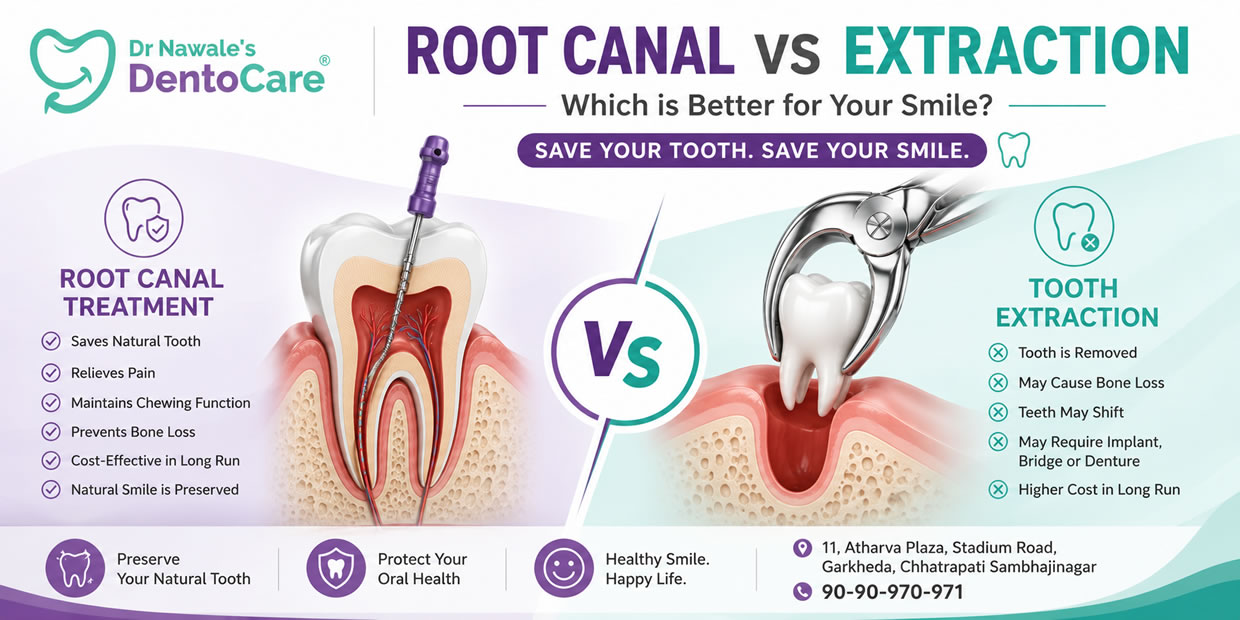
Root Canal vs Tooth Extraction: A Comparison
| Root Canal Treatment | Tooth Extraction |
|---|---|
| Saves your natural tooth | Removes the entire tooth |
| Maintains natural chewing | Requires replacement for proper function |
| Preserves jawbone and surrounding teeth | Can lead to bone loss and shifting teeth |
| Natural appearance | May need implant, bridge, or denture |
| Long-term cost is often lower | Replacement increases overall cost |
| Preferred when the tooth is restorable | Recommended only when the tooth cannot be saved |
Why Saving Your Natural Tooth is Better
Dentists always try to preserve natural teeth whenever possible because they offer benefits that artificial replacements cannot completely replicate.
1. Natural Chewing Function
Your natural tooth provides better biting force, comfort, and chewing efficiency than any replacement.
2. Maintains Jawbone Health
When a tooth is extracted, the surrounding jawbone gradually shrinks because it no longer receives stimulation from the tooth root. Preserving the natural tooth helps maintain bone volume and facial structure.
3. Prevents Teeth from Shifting
After extraction, neighboring teeth may drift into the empty space, leading to:
- Bite problems
- Food trapping
- Difficulty cleaning
- Increased risk of decay and gum disease
4. More Cost-Effective in the Long Run
Many patients believe extraction is the cheaper option. While the initial procedure may cost less, replacing the missing tooth with an implant or bridge usually makes extraction more expensive over time.
5. Better Appearance
Keeping your natural tooth helps maintain your smile and facial aesthetics without creating visible gaps.
When is Root Canal the Best Choice?
Root canal treatment is recommended when:
- The tooth has deep decay
- The nerve is infected
- There is severe sensitivity
- The tooth has an abscess
- Pain occurs while chewing
- The tooth structure is strong enough to be restored
At Dr Nawale’s DentoCare, every patient undergoes a thorough clinical examination and digital X-rays before recommending treatment.
When is Tooth Extraction Necessary?
Although dentists prefer saving teeth, extraction becomes necessary when:
- The tooth has a vertical root fracture
- Severe gum disease has destroyed supporting bone
- There is extensive damage below the gum line
- The tooth cannot support a crown
- Infection has made the tooth non-restorable
In these situations, extraction helps prevent the spread of infection and allows planning for a suitable replacement.
Is Root Canal Treatment Painful?
One of the biggest myths is that root canal treatment is painful.
The truth is that modern root canal procedures are performed under local anesthesia, making the treatment comfortable for most patients. In fact, a root canal usually relieves the pain caused by infection rather than causing it.
Patients at Dr. Nawale’s DentoCare benefit from advanced techniques and modern equipment designed to make treatment efficient and comfortable.
What Happens if You Don’t Replace an Extracted Tooth?
Ignoring a missing tooth can lead to:
- Bone loss
- Shifting of adjacent teeth
- Bite imbalance
- Difficulty chewing
- Increased wear on remaining teeth
- Changes in facial appearance
If extraction is unavoidable, replacing the missing tooth with a dental implant or bridge is generally recommended to restore function and prevent long-term complications.
Expert Opinion from Dr. Nitin Nawale & Dr. Sheetal Nawale
As experienced dentists in Chhatrapati Sambhajinagar (Aurangabad), Dr. Nitin Nawale and Dr. Sheetal Nawale follow a conservative approach to dentistry.
Their philosophy is simple:
“If a natural tooth can be saved safely and predictably, preserving it is usually the best option.”
Only when a tooth is beyond repair do they recommend extraction and discuss the most appropriate replacement options based on the patient’s oral health and long-term needs.
Why Choose Dr. Nawale’s DentoCare?
Patients across Chhatrapati Sambhajinagar trust Dr. Nawale’s DentoCare for:
- Experienced dentists
- Advanced Root Canal Treatment
- Digital Dental X-rays
- Modern sterilization protocols
- Comfortable and patient-friendly care
- Personalized treatment planning
- Comprehensive dental services under one roof
Whether you need a root canal, extraction, dental implant, or preventive dental care, the clinic focuses on providing evidence-based, patient-centered treatment.
Final Verdict: Root Canal vs Tooth Extraction
In most cases, Root Canal Treatment is the better choice because it preserves your natural tooth, maintains normal chewing function, protects your jawbone, and helps avoid the additional cost and complexity of replacing a missing tooth. Extraction should be considered only when the tooth cannot be restored or saved.
If you are experiencing severe tooth pain, swelling, or sensitivity, don’t delay treatment. Early diagnosis can often save your natural tooth and prevent more complex dental problems.
Visit Dr Nawale’s DentoCare
If you’re searching for the Best Root Canal Treatment in Chhatrapati Sambhajinagar (Aurangabad), schedule a consultation with Dr. Nitin Nawale or Dr. Sheetal Nawale. Their expertise, advanced technology, and commitment to preserving natural teeth can help you achieve a healthy, pain-free smile.
Clinic Details
Clinic: Dr Nawale’s DentoCare
Address: 11, Atharva Plaza, Stadium Road, Opposite Gurukrupa Farsan Mart, Kasliwal Nagar, Garkheda, Chhatrapati Sambhajinagar, Maharashtra 431009.
Contact Number: 90-90-970-971
Email: info@drnawaledentocare.com
Website: Dr Nawale’s DentoCare Official Website
Timings: Monday to Saturday, 10:00 AM to 8:00 PM.
Frequently Asked Questions (FAQ)
1. Which is better: Root Canal Treatment or Tooth Extraction?
In most cases, Root Canal Treatment (RCT) is the better option because it saves your natural tooth, maintains normal chewing function, preserves the jawbone, and prevents neighboring teeth from shifting. Tooth extraction is recommended only when the tooth is too severely damaged or infected to be restored.
2. Is a Root Canal more painful than a tooth extraction?
No. With modern anesthesia and advanced dental techniques, Root Canal Treatment is generally no more painful than getting a filling. In fact, it relieves the pain caused by infection. Tooth extraction may involve a longer healing period, especially if surgical removal is required.
3. How do I know if I need a Root Canal or an Extraction?
Your dentist will examine your tooth using a clinical evaluation and digital X-rays. If the tooth can be restored, a root canal is usually recommended. If the tooth has severe structural damage, advanced gum disease, or a vertical root fracture, extraction may be the best option.
4. How long does a Root Canal Treatment take?
Most root canal treatments are completed in one or two appointments, depending on the complexity of the infection and the condition of the tooth.
5. How long does it take to recover after a tooth extraction?
Recovery after a simple tooth extraction usually takes 7 to 10 days. Surgical extractions may require additional healing time. Following your dentist’s post-operative instructions helps ensure a smooth recovery.
6. Will I need a crown after a Root Canal?
In many cases, yes. Teeth that have undergone root canal treatment—especially molars and premolars—are often restored with a dental crown to improve strength, protect against fracture, and restore normal function.
7. What happens if I don’t replace a tooth after extraction?
Leaving a gap after extraction can lead to:
- Shifting of adjacent teeth
- Difficulty chewing
- Jawbone loss
- Bite problems
- Changes in facial appearance
Replacing the missing tooth with a dental implant, bridge, or denture helps restore function and maintain oral health.
8. Is Root Canal Treatment more expensive than tooth extraction?
The initial cost of extraction may be lower. However, when you include the cost of replacing the missing tooth with a dental implant or bridge, Root Canal Treatment is often the more cost-effective long-term solution.
9. Can every infected tooth be saved with a Root Canal?
Not always. If the tooth has a severe vertical fracture, extensive decay below the gum line, or insufficient remaining tooth structure, extraction may be necessary. An examination by an experienced dentist is required to determine the best treatment.
10. How successful is Root Canal Treatment?
Root Canal Treatment has a high success rate of over 90–95% when performed correctly and followed by proper restoration and regular dental care. Many treated teeth can last for decades or even a lifetime.
11. What are the signs that I may need a Root Canal?
Common symptoms include:
- Severe toothache
- Sensitivity to hot or cold that lingers
- Swollen gums
- Tooth discoloration
- Pain while chewing
- Pimple-like swelling on the gums
If you notice these symptoms, consult a dentist promptly.
12. Why choose Dr. Nawale’s DentoCare for Root Canal Treatment in Chhatrapati Sambhajinagar?
At Dr Nawale’s DentoCare, Dr. Nitin Nawale and Dr. Sheetal Nawale provide advanced, patient-focused dental care using modern technology, digital X-rays, and evidence-based treatment methods. The clinic is committed to preserving natural teeth whenever possible while ensuring comfortable, personalized care for every patient.
Related Keywords
- Root Canal Treatment in Chhatrapati Sambhajinagar
- Tooth Extraction in Chhatrapati Sambhajinagar
- Best Dentist in Chhatrapati Sambhajinagar
- Best Dental Clinic in Chhatrapati Sambhajinagar
- Root Canal Specialist in Chhatrapati Sambhajinagar
- Dental Clinic near Garkheda
- Dentist in Garkheda
- Dentist in Aurangabad
- Best Dentist in Aurangabad
- Root Canal Specialist in Aurangabad
- Tooth Extraction in Aurangabad
- Dental Clinic in Aurangabad
- Dr. Nawale’s DentoCare
- Dr. Nitin Nawale
- Dr. Sheetal Nawale