
Table of content
- What Are Dental Braces?
- What Are Clear Aligners?
- Braces vs Clear Aligners: Key Differences
- Braces: Advantages and Considerations
- Clear Aligners: Advantages and Considerations
- Which Is Better for Adults?
- Which Is Better for Teenagers and Children?
- Are Clear Aligners Suitable for Every Dental Problem?
- How to Choose Between Braces and Clear Aligners
- Why Professional Orthodontic Evaluation Matters
- Braces and Clear Aligners in Chhatrapati Sambhajinagar
- Frequently Asked Questions
- Conclusion
Root Canal vs Tooth Extraction: Which is Better for Your Smile?
A straight, well-aligned smile can improve not only your appearance but also your confidence and oral hygiene. If your teeth are crowded, crooked, spaced apart, or your bite is not properly aligned, orthodontic treatment may help. Today, patients have more choices than ever, with traditional braces and clear aligners being two of the most popular options.
But which one is better: braces or clear aligners?
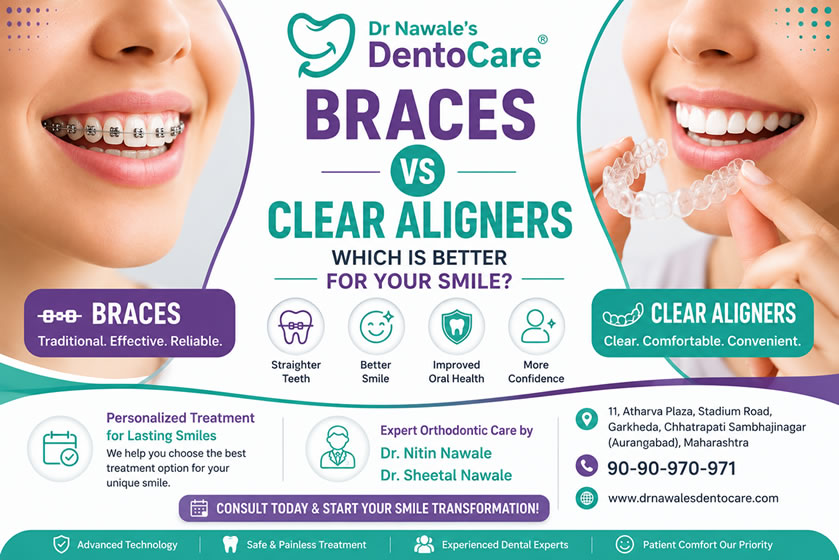
The answer is not the same for everyone. The right treatment depends on your teeth, bite, age, treatment goals, lifestyle, oral health and the complexity of your orthodontic problem. Braces use brackets and wires to gradually move teeth, while clear aligners use a series of customized, removable trays. Both are designed to move teeth gradually into healthier and more desirable positions.
At Dr Nawale’s DentoCare in Chhatrapati Sambhajinagar (Aurangabad), patients can discuss their orthodontic concerns and understand which treatment approach may be appropriate for their individual smile.
What Are Dental Braces?
Dental braces are fixed orthodontic appliances used to gradually move teeth and improve their alignment and bite. Traditional metal braces generally consist of brackets attached to the teeth and archwires that apply controlled forces to guide teeth toward planned positions. In some situations, elastic bands or other orthodontic components may also be used.
Braces have been used for many years and can be an effective option for a wide range of orthodontic problems, including crowded or crooked teeth and bite-related issues.
There are different types of braces available, including:
- Traditional metal braces
- Tooth-coloured or ceramic braces
- Other specialized fixed orthodontic appliances
The most appropriate type depends on the patient’s dental condition and treatment plan.
What Are Clear Aligners?
Clear aligners are thin, transparent, customized trays designed to fit closely over the teeth. Instead of brackets and wires, a patient typically wears a series of aligners, with each tray designed to move the teeth gradually according to the treatment plan.
One of the biggest attractions of clear aligners is their discreet appearance. They may be suitable for people who want orthodontic treatment without the more visible appearance of traditional metal braces.
Clear aligners can be used for several orthodontic concerns, including certain cases of:
- Crowded teeth
- Gaps between teeth
- Crooked teeth
- Overbite
- Underbite
- Open bite
- Crossbite
However, not every patient or every orthodontic problem is suitable for aligner treatment. A dental examination and appropriate treatment planning are important before deciding on aligners.
Braces vs Clear Aligners: Key Differences
| Feature | Braces | Clear Aligners |
|---|---|---|
| Appearance | More visible, especially metal braces | Clear and less noticeable |
| Fixed or removable | Fixed to teeth | Removable |
| Eating | Certain foods may need to be avoided | Usually removed while eating |
| Cleaning | Requires careful brushing around brackets and wires | Can remove trays to clean teeth |
| Responsibility | Treatment appliance stays in place | Patient must wear aligners as instructed |
| Lifestyle | May require adjustment during treatment | Can be convenient for many lifestyles |
| Suitability | Can be used for many orthodontic problems | Suitable for selected cases |
| Follow-up | Regular orthodontic appointments are required | Regular monitoring is also important |
| Appearance-conscious adults | May prefer ceramic options | Often preferred because they are discreet |
The most important point is that there is no universal winner between braces and clear aligners. Treatment should be selected according to individual clinical needs rather than appearance or popularity alone.
Braces: Advantages and Considerations
Dentists always try to preserve natural teeth whenever possible because they offer benefits that artificial replacements cannot completely replicate.
Advantages of Braces
One major advantage of braces is that they are fixed to the teeth. This means patients do not need to remember to put them back in after eating or cleaning.
Braces can be used for a broad range of orthodontic problems. Depending on the diagnosis, fixed appliances may be recommended when more controlled tooth movement is required. Orthodontic treatment may address crowded teeth, crooked teeth and bite problems.
Braces can also be a practical choice for younger patients or patients who may find it difficult to consistently wear removable aligners.
Things to Consider With Braces
Because braces are fixed, cleaning around brackets and wires requires extra care. Food can become trapped around orthodontic appliances, so good brushing and oral hygiene are especially important during treatment.
Some patients also need time to adjust to the brackets and wires, particularly during the early stages of treatment.
Clear Aligners: Advantages and Considerations
Advantages of Clear Aligners
The major benefit of clear aligners is their discreet appearance. They are considerably less noticeable than traditional metal braces, which can be particularly attractive to adults and professionals.
Another advantage is that aligners are removable. Patients can generally take them out for meals and oral hygiene, allowing normal brushing and flossing without brackets and wires in the way.
For people with busy professional or social lifestyles, the ability to remove the appliance may make aligner treatment more convenient.
Things to Consider With Clear Aligners
The biggest responsibility with clear aligners is patient compliance.
Unlike fixed braces, aligners can be removed. Therefore, successful treatment depends on wearing them as prescribed and following the treatment plan. Patients must also keep the aligners clean and maintain good oral hygiene.
Clear aligners are not automatically the better choice simply because they are modern or nearly invisible. The patient’s actual orthodontic problem must be evaluated before treatment is selected.
Which Is Better for Adults?
Adults often prefer clear aligners because they are less noticeable during meetings, professional interactions and social activities.
However, adult orthodontic treatment does not have to mean aligners. Adults may also be suitable candidates for traditional or ceramic braces depending on their dental condition and treatment objectives. Adults can receive orthodontic treatment even if they did not have braces during childhood.
For an adult with mild to moderate alignment concerns and good commitment to wearing removable trays, clear aligners may be an attractive option. Another adult with a more complex orthodontic problem may benefit from a fixed appliance.
The best decision should therefore come after a professional evaluation.
Which Is Better for Teenagers and Children?
Children and teenagers can also require orthodontic treatment to correct tooth alignment and bite problems. The timing of treatment depends on dental development and the patient’s specific condition.
Braces may be a useful option for children and teenagers because the appliances remain in place throughout treatment. Clear aligners can also be considered for selected younger patients, but the child’s ability and willingness to follow instructions are important.
Parents should not select an orthodontic treatment simply because it looks more attractive. A professional examination should determine the most appropriate option.
Are Clear Aligners Suitable for Every Dental Problem?
No.
Clear aligners can treat a range of alignment and bite problems, but their suitability depends on the individual case. The American Association of Orthodontists notes that aligners can be used for conditions such as crowding, spacing, overbite, underbite, open bite and crossbite, but treatment suitability still requires professional assessment.
Some complex cases may require fixed appliances or a combination of orthodontic approaches. NHS guidance also notes that more severe cases may sometimes require fixed braces and, in certain circumstances, additional specialist treatment.
This is why an online comparison cannot determine which treatment is right for you.
How to Choose Between Braces and Clear Aligners
When deciding between braces and clear aligners, consider these factors:
1. Your Dental Condition
The first question is not “Which looks better?” but “Which can effectively treat my condition?”
An examination of your teeth and bite helps determine the treatment options available.
2. Your Lifestyle
If you regularly attend meetings, presentations or public events, the discreet appearance of clear aligners may be appealing.
If remembering to wear removable trays may be difficult, fixed braces may be more practical.
3. Your Oral Hygiene Routine
Both treatments require good oral hygiene. With braces, you need to clean carefully around brackets and wires. With aligners, teeth and aligners need to be cleaned properly, and trays should be worn according to the prescribed plan.
4. Your Treatment Goals
Some patients primarily want straighter front teeth, while others require correction of a more complicated bite. The treatment plan should be based on the complete orthodontic problem.
5. Professional Assessment
A dentist or orthodontic professional can evaluate your teeth, gums, bite and overall oral health before recommending an appropriate treatment option.
Regular dental care during orthodontic treatment is important for maintaining oral health and monitoring the teeth being treated.
Why Professional Orthodontic Evaluation Matters
Choosing braces or aligners based only on advertisements, social media or before-and-after photographs can be misleading.
Every smile is different.
A professional dental assessment may include examination of tooth alignment, bite, gums and supporting structures. Depending on the case, photographs, digital scans or X-rays may be used as part of treatment planning.
At Dr Nawale’s DentoCare, treatment discussions can be based on your individual dental needs rather than a one-size-fits-all approach.
If you have crowded teeth, gaps, crooked teeth or concerns about your bite, a consultation can help you understand whether braces, clear aligners or another treatment approach may be suitable.
Braces and Clear Aligners in Chhatrapati Sambhajinagar
If you are searching online for braces in Chhatrapati Sambhajinagar, clear aligners in Chhatrapati Sambhajinagar, or a dentist for braces near Garkheda, choosing a clinic where your complete dental condition can be evaluated is important.
Clinic Details
Clinic: Dr Nawale’s DentoCare
Address: 11, Atharva Plaza, Stadium Road, Opposite Gurukrupa Farsan Mart, Kasliwal Nagar, Garkheda, Chhatrapati Sambhajinagar, Maharashtra 431009.
Contact Number: 90-90-970-971
Email: info@drnawaledentocare.com
Website: Dr Nawale’s DentoCare Official Website
Timings: Monday to Saturday, 10:00 AM to 8:00 PM.
Patients from Garkheda, Stadium Road, Cidco, Osmanpura, Jawahar Colony, Beed Bypass and surrounding areas of Chhatrapati Sambhajinagar can consult the clinic regarding orthodontic concerns and smile alignment.
Whether you are considering traditional braces or clear aligners, a personalized evaluation can help you understand your available options.
Frequently Asked Questions (FAQ)
Are clear aligners better than braces?
Not necessarily. Clear aligners are discreet and removable, but their suitability depends on the patient’s orthodontic condition. Braces may be preferable for some cases. A professional examination is required to determine the appropriate treatment.
Are braces painful?
Braces may cause temporary discomfort or pressure, especially after placement or adjustments, as the teeth gradually respond to orthodontic forces. Persistent or severe pain should be discussed with your dental professional.
Can adults get braces?
Yes. Adults can be candidates for orthodontic treatment, including braces or other orthodontic options, depending on their oral and dental condition.
Can teenagers use clear aligners?
Some teenagers may be suitable candidates for clear aligners. However, compliance with wearing instructions and appropriate case selection are important.
Can I eat normally with clear aligners?
Traditional fixed braces are attached to the teeth and cannot be removed by the patient for meals. Food choices and cleaning habits may need adjustment during treatment.
Can I remove traditional braces when eating?
Traditional fixed braces are attached to the teeth and cannot be removed by the patient for meals. Food choices and cleaning habits may need adjustment during treatment.
How long does orthodontic treatment take?
Treatment duration varies considerably depending on the complexity of tooth movement, bite correction, age, oral health and the treatment approach. Your dentist or orthodontic professional can provide an individualized estimate after examination.
Do I need retainers after braces or clear aligners?
Retention is an important part of orthodontic treatment because teeth can shift after active treatment. Your dental professional will recommend an appropriate retainer and wearing schedule based on your case.
Which is cheaper: braces or clear aligners?
The cost varies according to the type of treatment, complexity of the case, treatment duration and appliances required. It is better to compare treatment plans rather than choosing based only on the initial price.
Should I choose braces or clear aligners?
The best option depends on your individual teeth, bite, treatment goals, lifestyle and ability to follow the treatment plan. A dental consultation is the safest way to decide.
Conclusion
So, braces vs clear aligners: which is better for your smile?
There is no single answer for every patient.
Braces can be an effective option for many orthodontic conditions and remain a dependable treatment choice. Clear aligners provide a more discreet, removable option and can be suitable for selected cases.
The right treatment is the one that matches your dental condition, treatment goals and lifestyle.
Rather than choosing an orthodontic treatment because it is trending, schedule a dental evaluation and understand what is appropriate for your smile.
If you are looking for braces or clear aligners in Chhatrapati Sambhajinagar (Aurangabad), consult Dr. Nitin Nawale and Dr. Sheetal Nawale at Dr Nawale’s DentoCare, Garkheda for an individual assessment and guidance.
Your smile is unique. Your orthodontic treatment should be, too.
Related Keywords
- Braces vs Clear Aligners
- Braces vs aligners
- Clear aligners vs braces
- Braces or clear aligners
- Which is better braces or aligners
- Clear aligners benefits
- Braces benefits
- Advantages of clear aligners
- Advantages of braces
- Disadvantages of clear aligners
- Disadvantages of braces
- Clear aligners treatment
- Teeth straightening treatment
- Teeth alignment treatment
- Crooked teeth treatment
- Tooth Extraction in Chhatrapati Sambhajinagar
- Best Dentist in Chhatrapati Sambhajinagar
- Best Dental Clinic in Chhatrapati Sambhajinagar
- Root Canal Specialist in Chhatrapati Sambhajinagar
- Dental Clinic near Garkheda
- Dentist in Garkheda
- Dentist in Aurangabad
- Best Dentist in Aurangabad
- Root Canal Specialist in Aurangabad
- Tooth Extraction in Aurangabad
- Dental Clinic in Aurangabad
- Dr. Nawale’s DentoCare
- Dr. Nitin Nawale
- Dr. Sheetal Nawale