
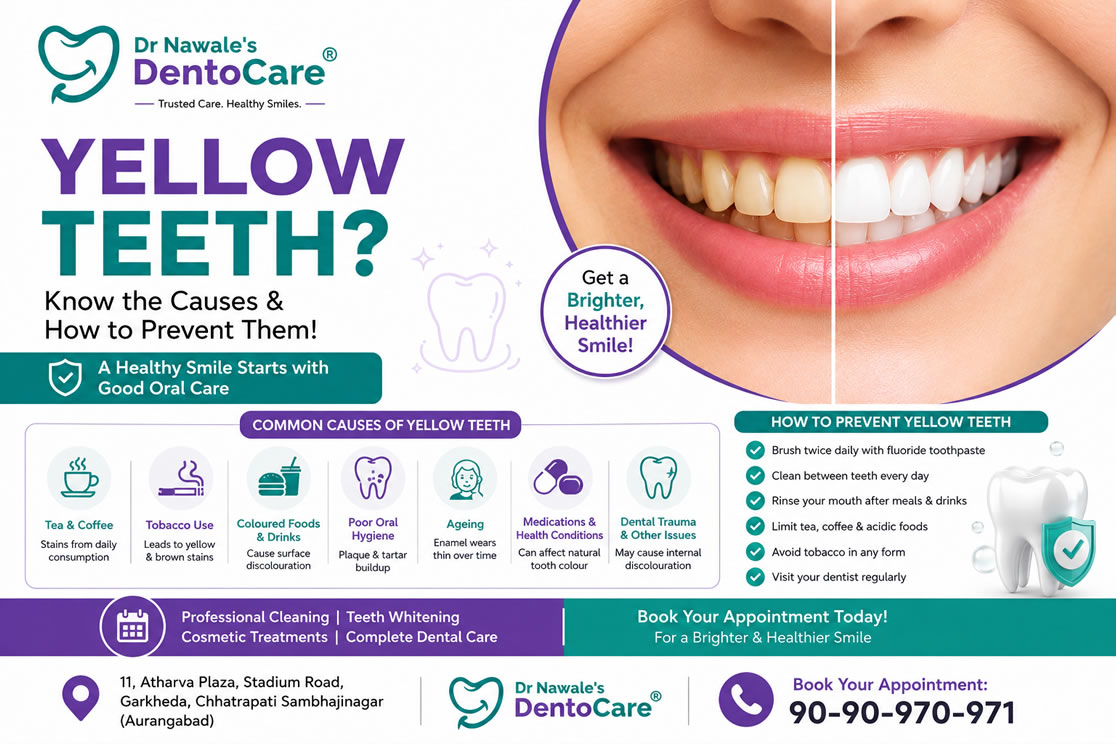
Why are my teeth turning yellow even though I brush every day?
This is one of the most common questions people ask about their smile.
Yellow or discoloured teeth do not always mean poor oral hygiene. Tooth colour is naturally different from person to person, and teeth can become more yellow because of surface stains, food and beverages, tobacco, plaque and tartar, ageing, enamel thinning, certain medications, fluorosis, trauma and other dental conditions.
The good news is that many causes of yellow teeth can be prevented or improved with appropriate oral care and professional dental treatment.
At Dr Nawale’s DentoCare, patients in Chhatrapati Sambhajinagar (Aurangabad) can get professional evaluation for tooth discoloration, dental cleaning, polishing and teeth-whitening options based on the actual cause of the staining. The clinic is located in Garkheda and offers teeth-whitening services as part of its dental care.
Table of content
- Are Yellow Teeth Normal?
- What Causes Yellow Teeth?
- Surface vs Internal Tooth Discoloration
- 10 Common Causes of Yellow Teeth
- Why Teeth Become Yellow With Age
- Can Tea and Coffee Make Teeth Yellow?
- Tobacco and Yellow Teeth
- Can Poor Oral Hygiene Cause Yellow Teeth?
- How to Prevent Yellow Teeth
- Professional Cleaning vs Teeth Whitening
- How Dr Nawale’s DentoCare Can Help
- Yellow Teeth Infographic
- When Should You See a Dentist?
- Why Choose Dr Nawale’s DentoCare?
- Expert Dentists in Chhatrapati Sambhajinagar
- Frequently Asked Questions
- Final Takeaway
Are Yellow Teeth Normal?
A slightly yellow or cream-coloured tooth is not necessarily unhealthy.
Natural tooth colour varies between individuals. Enamel is relatively translucent, and the naturally yellowish dentin underneath can influence the overall appearance of the tooth. As enamel becomes thinner with age, dentin may become more visible, making teeth appear darker or more yellow.
Therefore:
Yellow teeth do not automatically mean unhealthy teeth or poor brushing.
However, new, sudden, uneven or progressively worsening discoloration deserves professional evaluation.
What Causes Yellow Teeth?
Yellow teeth can result from external stains on the tooth surface or changes within the tooth itself.
Some common causes include:
- Tea and coffee
- Coloured foods and beverages
- Tobacco and smoking
- Plaque and tartar
- Inadequate oral hygiene
- Ageing
- Enamel thinning
- Natural tooth colour
- Fluorosis
- Certain medications
- Previous dental trauma
- Tooth decay
- Changes inside the tooth
Tooth discoloration is commonly classified as extrinsic or intrinsic, depending on where the discoloration originates.
Surface Stains vs Internal Discoloration
| Type | Where it occurs | Common causes | Possible approach |
|---|---|---|---|
| Extrinsic discoloration | On the outside of the tooth | Tea, coffee, tobacco, coloured foods, plaque/tartar | Cleaning, polishing and appropriate whitening |
| Intrinsic discoloration | Within the tooth structure | Ageing, fluorosis, trauma, some medications and developmental factors | Professional assessment and appropriate cosmetic treatment |
| Mixed discoloration | Surface + internal | Combination of lifestyle and natural tooth changes | Customized treatment plan |
Important: Whitening is not the right solution for every type of discoloration. The cause should be identified before treatment.
10 Common Causes of Yellow Teeth
1. Tea and Coffee
Tea and coffee are common parts of daily life in India. Both contain pigments that can contribute to surface staining over time.
Frequent consumption may gradually make teeth appear darker or yellowish.
How to reduce staining
- Rinse your mouth with water after drinking.
- Avoid continuously sipping staining beverages throughout the day.
- Maintain regular brushing and interdental cleaning.
- Consider professional cleaning if stains accumulate.
2. Tobacco and Smoking
Smoking and tobacco use can cause noticeable yellow or brown tooth staining.
Tobacco is also associated with several other oral-health problems, making quitting one of the most beneficial steps for your mouth and overall health.
If you use tobacco:
Talk to your dentist about quitting and have persistent stains professionally evaluated.
3. Poor Oral Hygiene
When plaque is not removed regularly, it can accumulate on teeth. Over time, hardened deposits such as tartar can contribute to a dull or stained appearance.
Poor oral hygiene can also increase the risk of:
- Tooth decay
- Gum disease
- Bad breath
- Tartar buildup
Regular brushing and cleaning between teeth are important parts of maintaining oral health.
4. Ageing
Teeth naturally change as we get older.
The enamel layer can become thinner or more translucent, allowing the yellowish dentin underneath to become more visible.
This means:
Teeth can become more yellow with age even when you maintain good oral hygiene.
Age-related discoloration can involve both internal and external factors.
5. Coloured Foods and Drinks
Several foods and beverages can contribute to surface staining.
Examples include:
- Tea
- Coffee
- Cola
- Dark sauces
- Curries with strong pigments
- Berries
- Other deeply coloured foods
You don’t necessarily have to eliminate every staining food from your diet.
Instead, focus on moderation, good oral hygiene and rinsing with water afterward.
6. Fluorosis
Excessive fluoride exposure while teeth are developing can sometimes cause changes in tooth appearance, including white, yellow or brown areas.
Fluorosis is different from ordinary surface staining and may require a different cosmetic approach.
If you have had discoloration since childhood, a dentist can determine whether it may be related to fluorosis or another enamel condition.
7. Certain Medications
Some medications can affect tooth colour, particularly when exposure occurs during tooth development.
For example, tetracycline exposure during childhood can cause intrinsic tooth discoloration. Certain other medications and medical conditions can also affect tooth appearance.
If you notice unusual discoloration, tell your dentist about relevant medication history.
8. Dental Trauma
An injury to a tooth can sometimes cause the tooth to change colour.
A single tooth that gradually becomes grey, dark or significantly different from neighbouring teeth should be evaluated by a dentist.
This is particularly important if the tooth has previously experienced:
- A fall
- Sports injury
- Accident
- Blow to the mouth
- Previous dental treatment
9. Enamel Wear and Thinning
Enamel protects the tooth underneath.
As enamel becomes thinner due to age, wear or other factors, the naturally darker dentin underneath may become more visible.
This can make teeth look more yellow even when there is no surface stain.
Important
Avoid aggressive brushing or unverified DIY whitening methods that may irritate your mouth or damage tooth surfaces.
10. Tooth Decay or Other Dental Problems
Not every dark or yellow spot is a stain.
A yellow, brown or dark area may sometimes be associated with:
- Tooth decay
- Damaged enamel
- A defective restoration
- Internal tooth changes
If you see a new spot, hole, discoloration or pain, get it checked rather than assuming it is simply staining.
When Do You Need a Dental Filling?
A filling may be considered when tooth decay has created a cavity but enough healthy tooth structure remains.
Common situations include:
1. Small or moderate cavities
A filling can replace the tooth structure lost due to decay.
2. Tooth-colored restoration
Composite resin can be used when an aesthetic, tooth-colored restoration is appropriate.
3. Limited tooth damage
If the remaining tooth structure is sufficiently strong, full coverage may not be necessary.
4. Replacement of an old filling
An existing filling may sometimes need to be replaced because of wear, leakage, fracture or recurrent decay.
The decision depends on the clinical condition rather than simply the age of the filling.
Why Are My Teeth Yellow Even Though I Brush Twice a Day?
Short answer:
Brushing helps remove plaque and some surface stains, but it cannot change the natural colour of teeth or remove every type of discoloration.
Yellow teeth can result from ageing, natural dentin colour, enamel thinning, food and drink stains, tobacco, fluorosis, medications or changes inside the tooth.
So if you brush regularly but still have yellow teeth, the issue may not be your brushing routine.
How to Prevent Yellow Teeth
You cannot prevent every type of tooth discoloration, but you can significantly reduce many common causes.
1. Brush Twice Daily
Brush your teeth twice a day using a suitable fluoride toothpaste and a soft-bristled toothbrush.
Avoid brushing aggressively.
2. Clean Between Your Teeth
Food and plaque can accumulate between teeth where a toothbrush may not reach effectively.
Use:
- Dental floss
- Interdental brushes
- Other dentist-recommended interdental cleaning aids
3. Drink Water After Tea or Coffee
Water can help rinse away food particles and pigments.
A simple habit:
Tea/Coffee → Water rinse → Continue your day
4. Reduce Tobacco Use
Avoiding smoking and tobacco is one of the best ways to reduce tobacco-related tooth staining and protect oral health.
5. Don’t Brush Immediately After Acidic Foods
After acidic foods or beverages, the tooth surface can temporarily be more vulnerable to abrasion.
Instead of brushing immediately, rinse with water and follow appropriate brushing timing.
6. Maintain Regular Dental Checkups
Professional dental examinations can identify:
- Plaque
- Tartar
- Tooth decay
- Gum problems
- Cracks
- Abnormal discoloration
Early detection makes treatment easier in many situations.
Can Professional Cleaning Remove Yellow Teeth?
It depends on why your teeth are yellow.
If the discoloration is caused primarily by plaque, tartar or surface stains, professional cleaning and polishing can make teeth look cleaner and brighter.
However, professional cleaning does not change the natural colour of the tooth or remove every type of intrinsic discoloration.
This is why diagnosis comes first.
Professional Cleaning vs Teeth Whitening
| Treatment | Main purpose | Best suited for |
|---|---|---|
| Professional Cleaning | Removes plaque, tartar and surface deposits | Plaque, tartar and surface stains |
| Polishing | Smooths and removes some surface stains | Extrinsic stains |
| Professional Teeth Whitening | Lightens suitable natural teeth | Certain types of tooth discoloration |
| Bonding | Masks selected discoloration or changes tooth shape | Specific cosmetic cases |
| Veneers | Covers the visible front surface | Selected persistent cosmetic discoloration |
| Crown | Restores a damaged tooth | Structurally compromised teeth |
The right treatment depends on the cause, severity and condition of your teeth and gums.
Can Yellow Teeth Become White Again?
Sometimes, yes.
But the result depends on the cause.
Surface stains
May improve significantly with professional cleaning and polishing.
Suitable natural tooth discoloration
May respond to dentist-supervised whitening.
Deep or intrinsic discoloration
May require alternative cosmetic treatments depending on the condition.
Restored or damaged teeth
Whitening may not change the colour of existing crowns, fillings or veneers in the same way it changes natural teeth.
That’s why a dental examination is important before choosing a whitening treatment.
Yellow Teeth Infographic
WHY ARE YOUR TEETH TURNING YELLOW?
TEA + COFFEE
☕
Surface stains
↓
TOBACCO
🚬
Yellow/brown staining
↓
PLAQUE + TARTAR
🦷
Dull or stained appearance
↓
AGEING
⌛
Enamel becomes thinner → dentin becomes more visible
↓
FLUOROSIS / MEDICATIONS
💊
May cause intrinsic discoloration
↓
TRAUMA / TOOTH PROBLEMS
⚠️
A single tooth may change colour
PREVENTION
Brush 2× daily
+
Clean between teeth
+
Drink water after staining foods/drinks
+
Avoid tobacco
+
Regular dental checkups
TREATMENT
Surface stains → Cleaning & polishing
Suitable discoloration → Professional whitening
Persistent intrinsic discoloration → Customized cosmetic treatment
When Should You See a Dentist for Yellow Teeth?
Book a dental examination if:
- Your teeth are becoming progressively yellow.
- One tooth has suddenly changed colour.
- You have yellow or brown spots that don’t disappear with brushing.
- You have tooth sensitivity.
- You have pain or swelling.
- You notice a hole in the tooth.
- You have heavy tartar buildup.
- Your teeth have become darker after an injury.
- Home whitening products are not producing the expected results.
A sudden or unexplained change in tooth colour should not automatically be treated as a cosmetic issue. A dentist can determine whether the discoloration is external staining or related to the tooth itself.
Why Choose Dr Nawale’s DentoCare?
Best Dental Clinic in Chhatrapati Sambhajinagar
Dr Nawale’s DentoCare provides comprehensive dental care in Garkheda, Chhatrapati Sambhajinagar (Aurangabad).
The clinic offers dental services including teeth whitening, cosmetic dentistry, preventive dentistry, root canal treatment, dental crowns and bridges, dental implants, orthodontic treatment and pediatric dentistry. Its local listing identifies it as a dental clinic and teeth-whitening provider. Dr Nawale’s DentoCare
Why patients choose Dr Nawale’s DentoCare
- Expert dental consultation
- Personalized treatment planning
- Professional teeth cleaning
- Teeth whitening options
- Cosmetic dental care
- Digital dental technology
- Comprehensive dental treatment
- Convenient location in Garkheda
- Care for children and adults
Expert Dentists in Chhatrapati Sambhajinagar
Dr. Nitin Nawale
Dr. Nitin Nawale is part of the dental team at Dr Nawale’s DentoCare, providing comprehensive dental care including restorative and cosmetic dental treatments.
For patients concerned about yellow teeth, the first step is identifying why the discoloration has occurred before deciding whether cleaning, whitening or another treatment is appropriate.
Dr. Sheetal Nawale
Dr. Sheetal Nawale is part of the dental team at Dr Nawale’s DentoCare and provides dental care for patients and families.
For children, tooth discoloration can sometimes have different causes from adult staining, so professional assessment is especially useful when discoloration appears unusual or persistent.
Frequently Asked Questions About Yellow Teeth
1. Why are my teeth yellow even after brushing?
Yellow teeth can result from natural tooth colour, ageing, enamel thinning, tea or coffee stains, tobacco, plaque, tartar, fluorosis, medications and other factors. Brushing alone cannot remove every type of discoloration.
2. Are yellow teeth unhealthy?
Not necessarily. Some teeth naturally have a yellow or cream tone. However, new or unusual discoloration may indicate staining, enamel changes or another dental problem and should be assessed if persistent.
3. Can tea make teeth yellow?
Yes. Tea contains pigments that can contribute to surface staining when consumed frequently over time.
4. Can coffee cause yellow teeth?
Yes. Coffee can contribute to extrinsic tooth staining.
5. Does smoking cause yellow teeth?
Yes. Smoking and tobacco use can cause noticeable yellow or brown staining.
6. Can professional cleaning whiten yellow teeth?
Professional cleaning can remove plaque, tartar and many surface stains. It does not necessarily change the natural colour of the tooth.
7. Can yellow teeth become white naturally?
Improving oral hygiene can help remove plaque and some surface stains, but natural tooth colour and intrinsic discoloration cannot always be changed through brushing alone.
8. Is teeth whitening safe?
Dentist-supervised whitening may be appropriate for suitable patients. However, whitening is not appropriate for every type of discoloration or every dental condition. A dental examination before treatment is recommended.
9. Can yellow teeth be caused by ageing?
Yes. As enamel becomes thinner and more translucent with age, the yellowish dentin underneath can become more visible.
10. Why is only one tooth turning yellow or dark?
A single tooth changing colour can have several causes, including previous trauma or changes inside the tooth. It should be examined by a dentist, particularly if the colour change is sudden or accompanied by pain.
11. Does whitening work on fillings, crowns and veneers?
Whitening primarily changes the colour of suitable natural teeth. Existing restorations such as crowns, veneers and fillings may not whiten in the same way, so treatment planning should be discussed with your dentist.
12. What is the best treatment for yellow teeth?
There is no single best treatment. Cleaning may be appropriate for plaque, tartar and surface stains, while professional whitening or other cosmetic treatments may be considered for certain types of discoloration.
13. Where can I get teeth whitening in Chhatrapati Sambhajinagar?
You can consult Dr Nawale’s DentoCare in Garkheda, Chhatrapati Sambhajinagar, for an evaluation of tooth discoloration and suitable cosmetic dental treatment options. The clinic provides teeth-whitening services. Dr Nawale’s DentoCare
Final Takeaway
Yellow teeth are common, but the reason behind the yellowing matters.
Tea, coffee, tobacco, plaque, tartar and coloured foods can cause surface staining, while ageing, enamel changes, fluorosis, medications, trauma and other factors can cause deeper or intrinsic discoloration.
Remember:
🦷 Brush twice daily
🧵 Clean between your teeth
💧 Rinse with water after staining foods and drinks
🚭 Avoid tobacco
☕ Limit frequent tea and coffee exposure
👨⚕️ Have regular dental checkups
✨ Choose professional whitening when appropriate
If you’re concerned about yellow or stained teeth, don’t simply start using aggressive DIY whitening remedies. Find the cause first, then choose the right treatment.
Looking for the Best Dental Clinic in Chhatrapati Sambhajinagar?
Many patients from:
- Garkheda
- Kasliwal Nagar
- Beed Bypass
- CIDCO
- Jalna Road
- Samarth Nagar
- Ulkanagari
- Bajaj Nagar
- Seven Hills
- Usmanpura
visit Dr Nawale’s DentoCare for comprehensive dental care. The clinic is located at Stadium Road, Garkheda, Chhatrapati Sambhajinagar.
Dr Nawale’s DentoCare
📍 11, Atharva Plaza, Stadium Road, Garkheda, Chhatrapati Sambhajinagar (Aurangabad)
📞 90-90-970-971