
Table of Content
- What Is Re-Root Canal Treatment (Re-RCT)?
- Why Does a Root Canal Treatment Fail?
- Signs You May Need Re-RCT
- Can a Previously Root-Canal-Treated Tooth Be Saved?
- How Is Re-Root Canal Treatment Done?
- Is Re-RCT Painful?
- Re-RCT vs. Tooth Extraction
- How Long Does Re-RCT Take?
- What Happens After Re-RCT?
- How Is a Failed Root Canal Diagnosed?
- Why Choose Dr Nawale’s DentoCare for Re-RCT?
- Re-RCT in Garkheda, Chhatrapati Sambhajinagar
- Frequently Asked Questions About Re-RCT
- Book a Consultation at Dr Nawale’s DentoCare
Have you already had a root canal but are experiencing pain, swelling, or infection again? You may not necessarily need to lose the tooth. In selected cases, Re-Root Canal Treatment (Re-RCT), also called root canal retreatment, can be considered to treat persistent or recurring problems and help preserve the natural tooth. The need for retreatment depends on the condition of the tooth, previous treatment, root anatomy, remaining tooth structure, restoration and the presence of infection or fracture.
If you are looking for Re-Root Canal Treatment in Chhatrapati Sambhajinagar, understanding why an earlier RCT may fail, what Re-RCT involves, and whether your tooth can be saved can help you discuss the right treatment option with your dentist.
What Is Re-Root Canal Treatment (Re-RCT)?
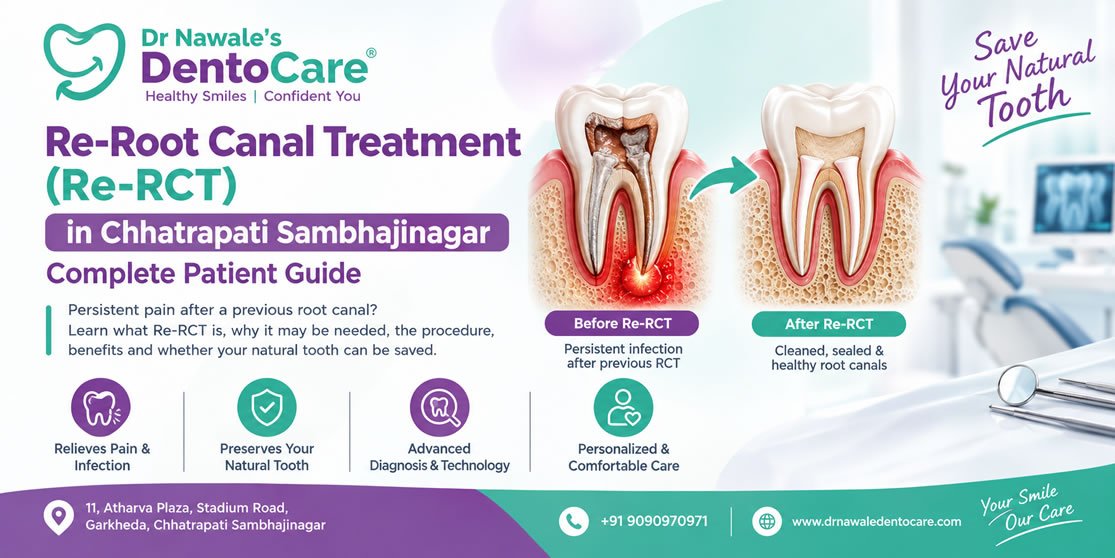
Re-Root Canal Treatment (Re-RCT) is a second root canal procedure performed on a tooth that has previously undergone root canal treatment but has not healed as expected or has developed a new problem.
During Re-RCT, the dentist reopens the treated tooth, removes the previous root canal filling material, examines the canals, identifies any untreated areas or problems, cleans and disinfects the canals, and then fills and seals them again. A suitable final restoration may then be required to protect the tooth.
In simple terms:
First RCT → problem persists or returns → tooth is evaluated → Re-RCT may be considered.
However, not every painful root-canal-treated tooth needs Re-RCT. A proper clinical examination and dental imaging are important before deciding on treatment.
Why Does a Root Canal Treatment Fail?
A root canal can sometimes fail to heal properly or develop a new problem months or even years after treatment. This does not automatically mean that the original treatment was performed incorrectly.
Possible reasons include:
1. Missed or untreated canals
Some teeth have complex root canal anatomy. A narrow, curved or additional canal may be difficult to identify during the original treatment. If bacteria remain in an untreated canal, infection can persist.
2. Complex root canal anatomy
Root canals can have curves, branches and unusual configurations. These anatomical variations can make cleaning and sealing challenging.
3. Incomplete cleaning or sealing
If infected material or bacteria remain inside the canal system, or if the canals are not adequately sealed, infection may persist.
4. Reinfection
A previously treated tooth can become infected again if bacteria gain access through new decay, a leaking restoration, or another pathway.
5. Leakage around a crown or filling
A damaged, loose or broken crown or filling can allow bacteria to enter the tooth.
6. New dental decay
Decay developing around or underneath a restoration can potentially expose the root canal filling to bacteria and contribute to reinfection.
7. Tooth or root fracture
A crack or fracture may affect whether a tooth can be predictably treated again. In some situations, extraction may ultimately be necessary.
What Are the Signs You May Need Re-RCT?
A previously root-canal-treated tooth should be evaluated if you develop symptoms such as:
- Persistent or recurring tooth pain
- Pain while biting or chewing
- Swelling around the tooth
- Tenderness around the gum
- A recurring pimple or boil on the gum
- Repeated infection
- Symptoms returning after earlier improvement
- Persistent discomfort around a previously treated tooth
- An abnormal area around the root seen on dental imaging
Importantly, some teeth with persistent infection may not cause significant pain. This is why dental examination and appropriate imaging can be important even when symptoms are mild.
If you notice swelling, recurring infection or significant pain after an earlier RCT, don’t simply assume that the tooth has to be extracted.
Can a Tooth That Has Already Had RCT Be Treated Again?
Yes, some previously root-canal-treated teeth can be treated again with Re-RCT. However, the decision depends on several factors.
Your dentist may assess:
- The amount of healthy tooth structure remaining
- The quality of the previous root canal treatment
- Root canal anatomy
- Presence and extent of infection
- Condition of the existing crown or filling
- Whether there is a crack or fracture
- Whether the tooth can be restored properly
- The position and function of the tooth
If the tooth is considered restorable and the cause of the problem can potentially be addressed, retreatment may be an option.
In other cases, alternatives such as endodontic surgery or extraction may need to be discussed.
How Is Re-Root Canal Treatment Done?
The exact procedure varies according to the tooth and the reason for the previous treatment failure, but Re-RCT generally involves several stages.
1. Dental examination
The dentist reviews your symptoms, previous dental treatment and the condition of the tooth.
2. X-ray and dental imaging
Dental X-rays can help assess the roots and surrounding bone. In selected cases, CBCT imaging may be considered when three-dimensional information is clinically useful.
3. Treatment planning
The dentist evaluates whether retreatment is appropriate and discusses alternatives with you.
4. Removal of previous root canal material
The tooth is reopened and the previous root canal filling material may need to be removed. If a crown, post or other restorative material prevents access, additional procedures may be required.
5. Locating the canals
The dentist carefully examines the canal system for untreated canals, unusual anatomy or other problems.
6. Cleaning and disinfection
The canals are cleaned and disinfected to reduce the bacterial load and remove remaining infected material.
7. Shaping the canals
The canals are prepared appropriately so they can be thoroughly cleaned and subsequently sealed.
8. Filling and sealing
The cleaned canals are filled and sealed to help prevent bacterial re-entry.
9. Final restoration
Depending on the tooth and its condition, a permanent filling or crown may be recommended to protect the tooth and restore function.
10. Follow-up
Follow-up allows the dentist to assess healing and the condition of the tooth over time.
Root canal retreatment can be more technically challenging than initial RCT because existing filling materials, crowns, posts or altered anatomy may need to be managed.
Is Re-RCT Painful?
Re-RCT is generally performed under local anaesthesia, so you should not normally feel significant pain during the procedure.
You may experience pressure or sensations during treatment. After the procedure, some tenderness or discomfort can occur for a few days while the tissues around the tooth recover.
If you experience severe or persistent pain, increasing swelling, or a return of your previous symptoms, contact your dentist for advice.
Re-RCT vs Tooth Extraction: Which Is Better?
There is no single answer that is right for every patient. If a tooth can be predictably restored, preserving the natural tooth may be considered. If the tooth has an extensive fracture or cannot be adequately restored, extraction may be recommended.
| Factor | Re-RCT | Tooth Extraction |
|---|---|---|
| Natural tooth | Attempts to preserve it | Tooth is removed |
| Main approach | Clean and reseal the existing root canals | Remove the affected tooth |
| Healing | Healing occurs around the treated tooth | Extraction socket needs to heal |
| Future treatment | May require final crown/restoration | Replacement may involve implant, bridge or denture |
| Suitability | Depends on tooth condition and restorability | May be required when tooth cannot be predictably saved |
| Cost | Depends on complexity and restoration required | Includes extraction and potentially future tooth replacement |
When possible, preserving a natural tooth can avoid the need for tooth replacement. However, extraction can be the appropriate treatment when a tooth cannot be predictably restored or has certain fractures or other significant structural problems.
How Long Does Re-RCT Take?
The duration of Re-RCT varies considerably.
It depends on:
- Which tooth is being treated
- Number and shape of the canals
- Complexity of the previous RCT
- Presence of old filling material
- Existing crown or post
- Blocked or calcified canals
- Presence of infection
- Need for additional procedures
- Type of final restoration required
Therefore, it is better to discuss the expected number and duration of appointments with your dentist after examination rather than relying on a fixed treatment time.
What Happens After Re-RCT?
After retreatment, your dentist may provide specific instructions depending on your case.
Generally:
- Follow the prescribed post-treatment instructions.
- Maintain regular brushing and flossing.
- Avoid putting excessive pressure on the treated tooth until advised.
- Take medicines only as directed by your dentist or doctor.
- If a temporary filling or restoration is placed, take care not to damage it.
- Complete the recommended permanent restoration or crown.
- Attend follow-up appointments.
A final restoration is particularly important when the tooth requires additional protection.
How Do Dentists Diagnose a Failed Root Canal?
A dentist does not diagnose failed RCT based on pain alone.
The evaluation may include:
Symptoms and dental history
Your dentist may ask when the pain started, whether it occurs during chewing and whether you have experienced swelling or previous infection.
Clinical examination
The tooth, gums and surrounding tissues are examined.
Dental X-ray
X-rays can provide information about the roots and surrounding bone.
CBCT when clinically indicated
Three-dimensional imaging may be recommended in selected complex cases when conventional X-rays do not provide enough information.
The purpose is to identify the cause of the problem and determine whether retreatment is appropriate, rather than automatically assuming that every previously treated tooth requires another root canal.
Why Choose Dr Nawale’s DentoCare for Re-RCT in Chhatrapati Sambhajinagar?
Patients looking for Re-RCT in Chhatrapati Sambhajinagar can consider Dr Nawale’s DentoCare in Garkheda for a comprehensive dental evaluation and treatment planning.
The clinic provides dental care with a focus on accurate diagnosis, patient comfort and appropriate treatment planning.
Dental care at Dr Nawale’s DentoCare includes:
- Dr. Nitin Nawale and Dr. Sheetal Nawale
- Comprehensive dental care
- Clinical evaluation before treatment
- Modern dental technology
- Digital Intraoral Scanner
- Dental X-ray facilities
- Treatment planning based on individual dental conditions
- Focus on preserving natural teeth when clinically possible
If you have previously undergone RCT and are experiencing pain, swelling or recurring infection, the first step is to determine why the tooth is causing problems and whether Re-RCT is actually suitable.
Visit Dr Nawale’s DentoCare
Dr Nawale’s DentoCare
11, Atharva Plaza, Stadium Road,
Garkheda, Chhatrapati Sambhajinagar
📞 +91 9090970971
🕒 Monday to Saturday | 10:00 AM – 8:00 PM
🌐 www.drnawaledentocare.com
If you are experiencing problems after a previous root canal, schedule an evaluation to understand whether Re-RCT may be suitable for your tooth.
When Should You See a Dentist After a Root Canal?
Contact your dentist if you experience:
- Persistent or increasing tooth pain
- Pain when biting
- Swelling
- A recurring gum pimple or discharge
- Symptoms that return after previous improvement
- A loose or broken crown/filling
- New sensitivity or discomfort around a previously treated tooth
After treatment, severe pain or pressure lasting more than a few days, visible swelling, an uneven bite, loss of a temporary restoration, or return of previous symptoms should be discussed with your dentist.
If facial swelling is rapidly increasing, you have difficulty breathing or swallowing, or you feel seriously unwell, seek urgent medical/dental care.
Frequently Asked Questions About Re-RCT
1. What is Re-RCT?
Re-RCT, or Re-Root Canal Treatment, is a second root canal procedure performed on a previously treated tooth when the tooth has persistent or recurring infection or another problem requiring further endodontic treatment.
2. Why does a root canal fail?
Possible reasons include untreated canals, complex anatomy, inadequate cleaning or sealing, reinfection, new decay, leakage around a restoration, or tooth/root fracture.
3. Can a failed root canal be treated again?
Yes, some failed root canal-treated teeth can be retreated. Suitability depends on the tooth’s structure, root anatomy, infection, restorability and the reason for the previous treatment problem.
4. Is Re-RCT painful?
Re-RCT is normally performed under local anaesthesia. Some tenderness or discomfort may occur after treatment and generally improves as the tissues heal.
5. How long does Re-RCT take?
The treatment time varies according to the tooth, complexity of the previous RCT, root anatomy, infection and restoration. Your dentist can provide a more accurate estimate after examination.
6. How much does Re-RCT cost in Chhatrapati Sambhajinagar?
There is no single fixed cost for every patient. The fee can vary depending on the tooth, complexity, previous treatment, imaging, removal of existing restorations and the final restoration required. A dental evaluation is necessary for an individual estimate.
7. Is Re-RCT better than tooth extraction?
If a tooth can be predictably restored, retreatment may provide an opportunity to preserve the natural tooth. However, extraction may be appropriate when the tooth cannot be predictably restored or has certain fractures.
8. Can infection return after Re-RCT?
Although retreatment aims to address the source of infection and seal the canals, healing is not guaranteed in every case. Further treatment may sometimes be required.
9. Do I need a crown after Re-RCT?
A crown or another suitable restoration may be recommended depending on the tooth’s condition and amount of remaining structure. Your dentist will determine the appropriate restoration.
10. When should I see a dentist for pain after RCT?
If pain persists, returns after a period of improvement, occurs during biting, or is associated with swelling or recurring infection, arrange a dental examination.
11. Is Re-RCT possible for every tooth?
No. The condition of the tooth, remaining structure, fracture status, root anatomy and ability to restore and adequately treat the canals all affect whether Re-RCT is appropriate.
12. Where can I get Re-RCT in Chhatrapati Sambhajinagar?
Patients looking for Re-RCT in Garkheda can consult Dr Nawale’s DentoCare, 11 Atharva Plaza, Stadium Road, Garkheda, Chhatrapati Sambhajinagar, for evaluation and treatment planning.
13. Where can I get root canal retreatment in Garkheda?
Patients looking for root canal retreatment in Garkheda can visit a dental clinic for a clinical examination and appropriate dental imaging. At Dr Nawale’s DentoCare, the dentist can assess the condition of the previously treated tooth and determine whether Re-RCT is appropriate.
14. What should I do if my root canal tooth hurts again?
If a tooth that previously received RCT starts hurting again, do not ignore recurring pain or swelling. Schedule a dental examination to identify the cause. Possible reasons include reinfection, inadequate previous treatment, leakage, missed canal anatomy, new decay, or tooth damage. Your dentist can determine whether Re-RCT, another treatment, or extraction is appropriate.
15. Can a failed RCT tooth be saved?
In some cases, yes. A previously root-canal-treated tooth may be suitable for Re-RCT if the tooth has enough healthy structure and can be predictably treated. However, not every failed RCT tooth can be saved. The decision requires an individual clinical examination and appropriate imaging.
16. What is the cost of Re-RCT in Chhatrapati Sambhajinagar?
The cost of Re-RCT varies from tooth to tooth and depends on factors such as whether it is a front or back tooth, the number and complexity of canals, previous treatment, removal of posts/crowns, required imaging, and whether additional procedures are necessary. Published dental pricing in India shows substantial variation, so it is better to obtain a case-specific estimate after examination rather than publish a misleading fixed price.
Expert Information
Dr. Sheetal Nawale
Dr Nawale’s DentoCare
Chhatrapati Sambhajinagar
Looking for the Best Dental Clinic in Chhatrapati Sambhajinagar?
Many patients from:
- Garkheda
- Kasliwal Nagar
- Beed Bypass
- CIDCO
- Jalna Road
- Samarth Nagar
- Ulkanagari
- Bajaj Nagar
- Seven Hills
- Usmanpura
visit Dr Nawale’s DentoCare for comprehensive dental care. The clinic is located at Stadium Road, Garkheda, Chhatrapati Sambhajinagar.
Dr Nawale’s DentoCare
📍 11, Atharva Plaza, Stadium Road, Garkheda, Chhatrapati Sambhajinagar (Aurangabad)
📞 90-90-970-971